I don’t have good habitat for Varied Thrushes, but I get to see them occasionally in winter. This female was poking around under the feeder recently, until the resident male American Robin chased her off.
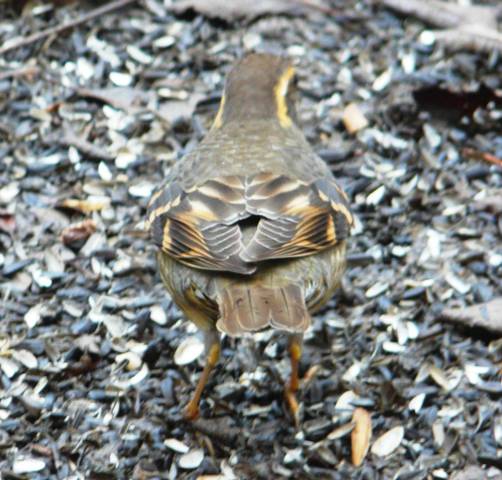
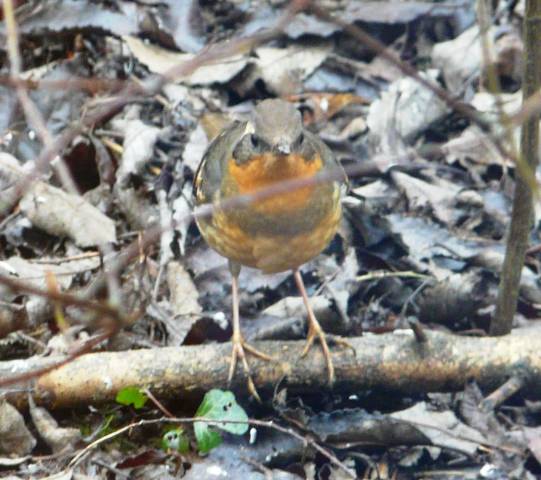
I don’t have good habitat for Varied Thrushes, but I get to see them occasionally in winter. This female was poking around under the feeder recently, until the resident male American Robin chased her off.
My first lifer of 2009 was a Slaty-backed Gull that has been hanging out in downtown Portland lately. It was a pretty painless twitch on the lifelist; 1. learn about the bird from email 2. drive downtown and find a parking space 3. find the gull standing on a light on the Broadway Bridge 4. ka-ching!
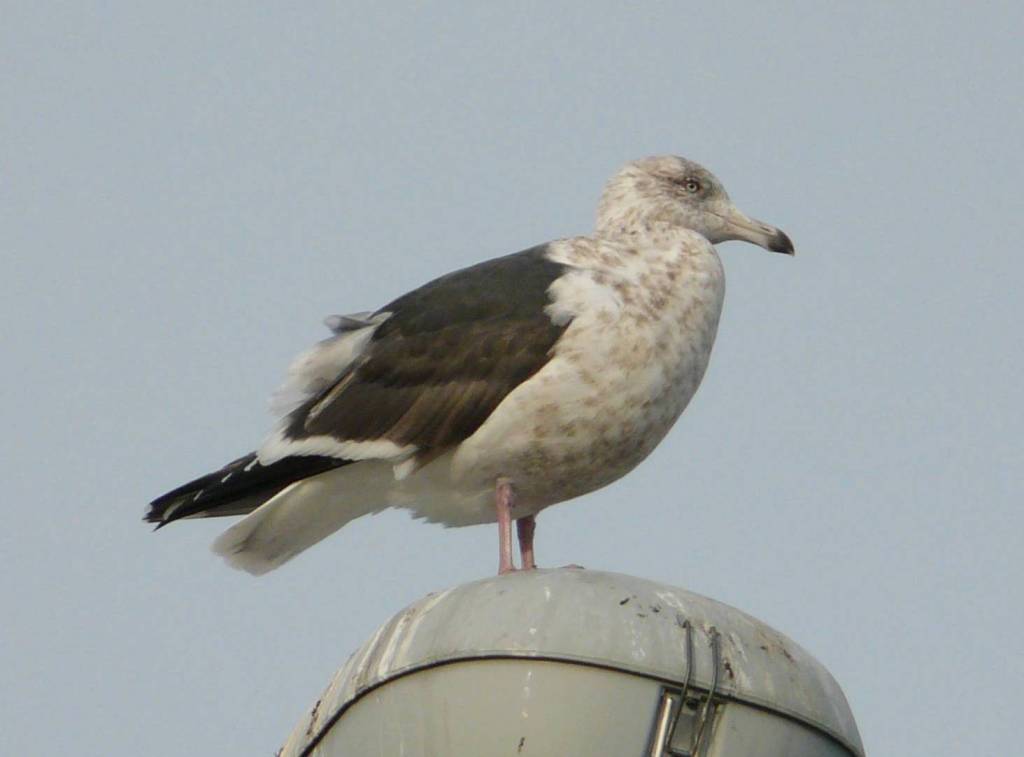
While I didn’t have to work very hard for this particular bird, it takes a well-earned spot on my list. I have been studying gulls rather intently for several years, learning to recognize the common species. (One needs to be familiar with the common birds if you want to recognize a rarity when you see one.) Slaty-backed has been very high on my want-list for two reasons. First, it is normally found in Asia, so it is hard to find in Oregon. Second, several years ago I thought I had found one, only to learn that I had made an identification error. While the incident was rather embarrassing (I immediately reported the bird, as I should have.) it did provide a valuable opportunity to learn what a Slaty-backed Gull really should look like.
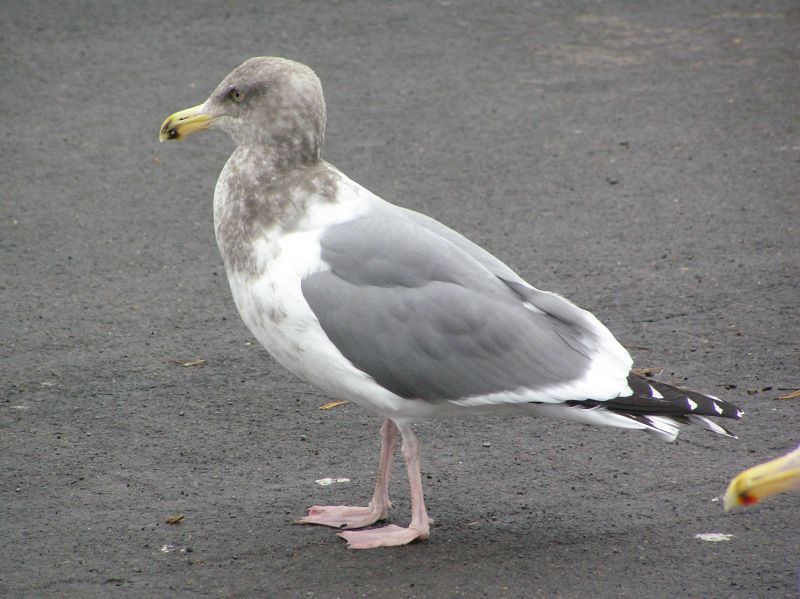
This is the bird that got me excited a few years ago. It is actually a third-cycle WesternXGlaucous-winged hybrid. It bears some similarities to a Slaty-backed, but the mantle is too light, the markings on the head are too evenly mottled, and the bill is too fat and bulbous. The pale eye on this bird is unusual, adding to my confusion. While many birders pointed out my error, one actually explained why this wasn’t a Slaty-backed Gull, providing me with a great boost in my gull identification skills.

So while I didn’t need a lot of luck or effort to see this particular bird, seeing it provided a bit of closure for one facet of my birding development. Thus I join this third-cycle Slaty-backed Gull in the Happy Dance to celebrate another tick on the life list.
I hope to never meet someone who doesn’t like Bushtits. These little balls of fluff with long tails are always a treat to see.

Despite their tiny size, they are very vocal and come very close to people as they glean small insects from the foliage. It is difficult for such a small creature to maintain its body heat, so Bushtits huddle together for warmth, build enclosed insulated nests, and eat about 80% of their own weight in food every day. In addition to insects, they will eat suet or peanut butter at feeders, and will occasionally take little bits of sunflower seed that have softened in the rain.
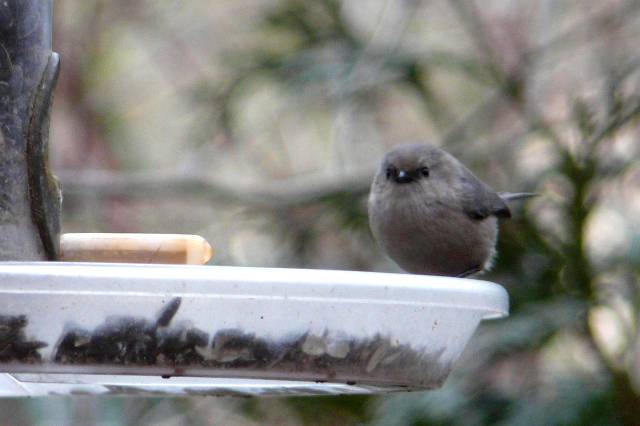
unbearably cute
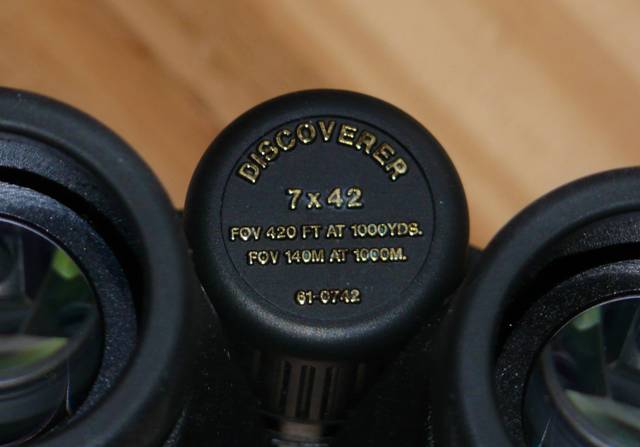
Last week I mailed by trusty binocular to the repair center in Rhode Island to have the focusing mechanism upgraded. The original mechanism is very slow, causing me to miss a lot of birds. The new mechanism will be faster. So for the next few weeks I will be using my back-up binoc, which requires an adjustment on my part.
I have always used 10-power binoculars. I like the extra “reach” I get with 10X, especially when looking at distant shorebirds on mudflats, hawks in flight, and seabirds at the coast. The glass I am using now is 7-power, and the world looks smaller.
There are advantages to a 7X binoc. Since it doesn’t magnify as much, it provides a wider field of view, making it easier to find birds in heavy cover. The image also tends to be slightly brighter in a 7X glass and there is less magnification of any shaking in my hands, so the image is more stable. (If you ever want a demonstration of just how much your hands shake, take your binocular out at night and focus on a single star. You will be amazed at how much that little point of light jumps around. Luckily, our brains filter out much of this movement when we are watching birds.) I bought this 7X binoc for pelagic trips. The movement of the waves combined with a vibrating diesel engine make 10X binocs practically useless.
Despite these advantages, I still miss my 10X binocular. Yes, the 7X glass provides a clear, bright, stable image. And yes, a smaller image might force me to look harder at subtle details. But I like the full-frame views afforded by 10X. I like being able to count the four primary tips projecting on the wing of an American Golden Plover and seeing the leg feathering on a Rough-legged Hawk. Call me weak, but I like the extra power. Maybe it is just a guy thing.
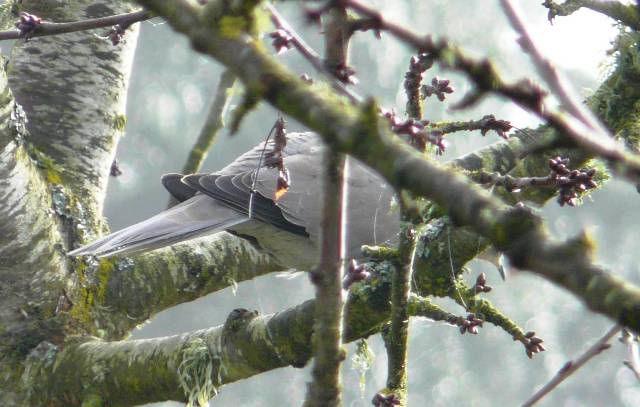
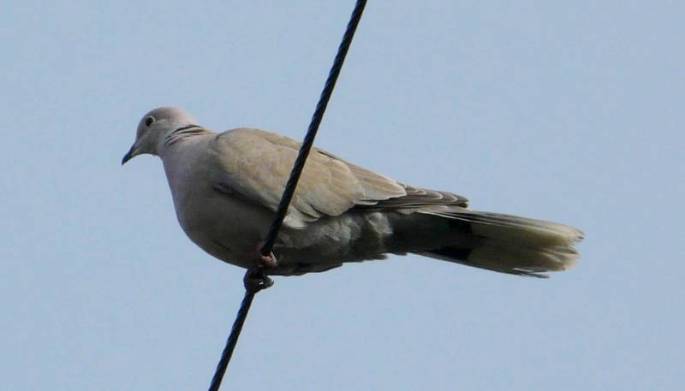
Despite the fact that much of this bird is hidden from view, all the key field marks (broad square tail, dark primaries that contrast with the rest of the wing, and the lack of spots) reveal this bird to be a Eurasian Collared-Dove. Native to Europe and most of Asia, this species was introduced to the Bahamas in 1974. It made its way to Florida by 1980, and has been spreading rapidly across North America, reaching Oregon in 1998. These individuals in these photos were part of a small flock on Sauvie Island.
Here is a view of the underside of the tail, showing the broad pale terminal band, the dark base, and the white edges.
I saw my first Eurasian Collared-Dove in Hugoton, KS in 2000. I made a special trip to find that bird. Now the species is so numerous in western Kansas you can’t spit without hitting a Eurasian Collared-Dove. They will probably be equally successful in Oregon.
Portland’s Westmoreland Park is a great place to find a variety of gull species during winter. Seven species and one hybrid are regular, and there is always the possibility of something more unusual showing up.
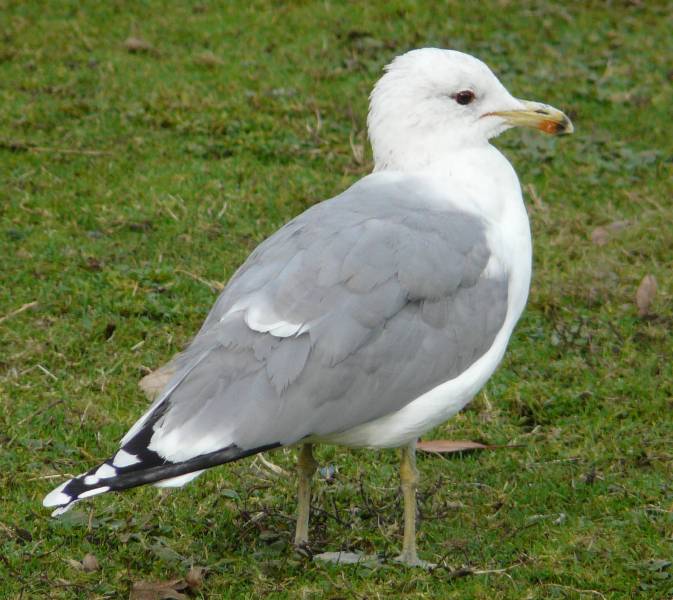
California Gull: medium-gray mantle, long dark wingtips that extend well beyond the tail, long straight bill with both red and black gonydeal spots, yellowish legs and feet with blue-gray cast.

Ring-billed Gull: smaller size, neat black ring around bill, long dark wingtips, yellow legs and feet.

Here’s the Ring-billed Gull at rest. Note the fine streaking on the head and the red orbital ring.
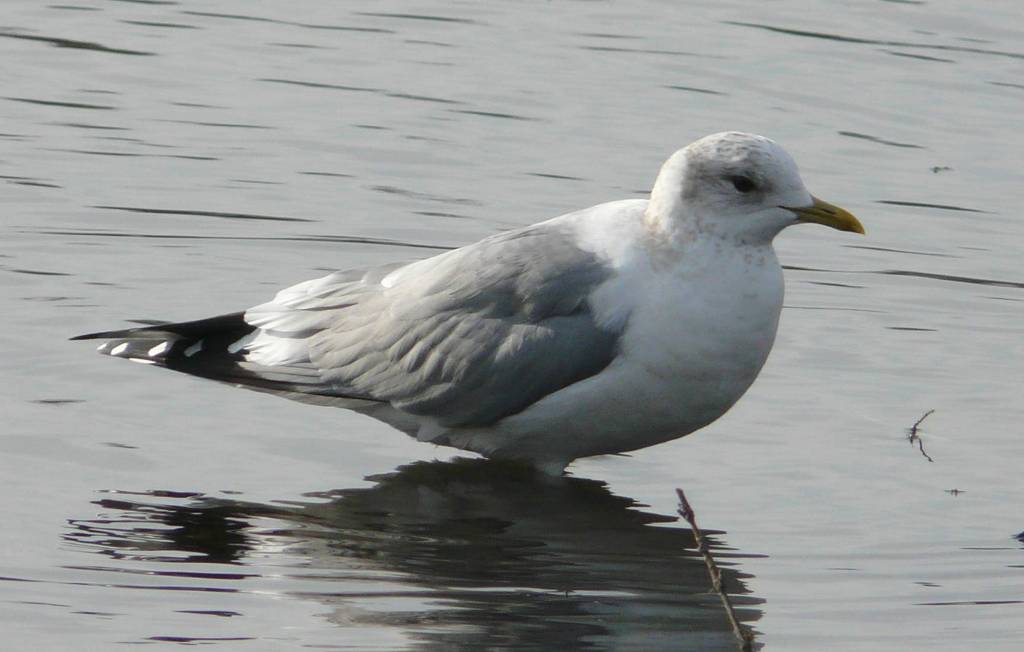
Mew Gull: petite yellow bill, round head, long wing extension. These small gulls will mix with the Ring-billed flock, but generally don’t mix with the larger gulls.
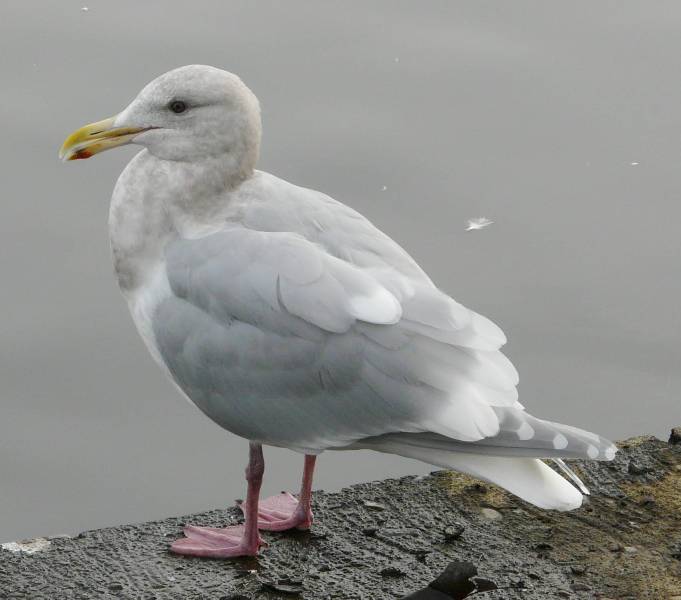
Glaucous-winged Gull: Note the lack of contrast on this bird. The short wingtips are the same color as the mantle. The head and upper breast are covered with an even blurry mottling. The only parts that don’t blend in are the pink legs and feet.

Western Gull: large size, dark gray mantle, short black wingtips, never any marks on the head – even in winter. This species is much more common on the coast, but a few make it in to the Willamette Valley in winter.

Western Gull X Glaucous-winged Gull hybrid (Olympic Gull): an even blending of characteristics of both parent species. The mantle is darker than a pure GW, but Westerns never show this much mottling on the head and neck. The wingtips are dark, but not actually black. You can tell this is a third cycle individual by the tiny bit of black on the tail and by the odd pattern on the bill. These hybrids show a great deal of variation, and are often the most numerous gulls in the area.
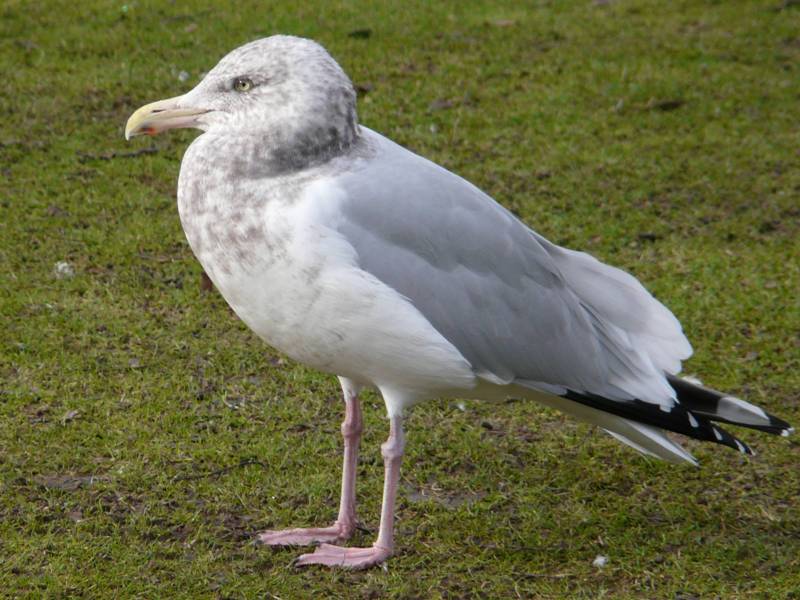
Herring Gull: sloping forehead, pale eye, bill not too thick, black wingtips that extend beyond the tail.

Thayer’s Gull: rounded forehead, thin bill, dark eye (usually, not always), long black wingtips with much more white on the underside.
Located on the east side of Portland, Powell Butte Nature Park (Birding Oregon p. 66) offers a variety of birds and some nice views of the nearby mountains.
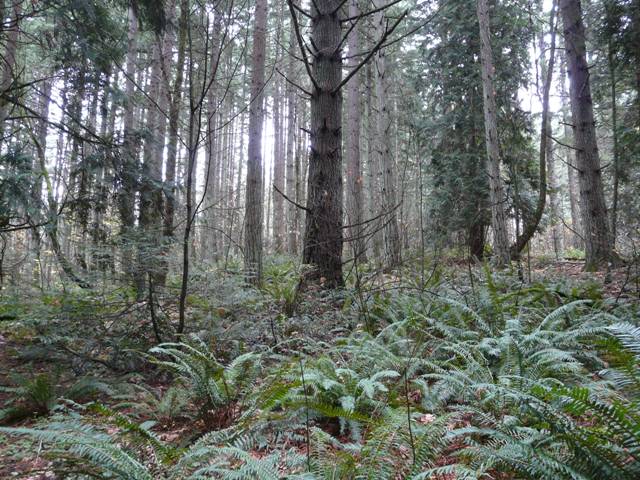
The butte is tall enough to produce its own rain shadow, so the western slope is forested with a dense understory.

The top of the butte is drier and dominated by grassland and small scattered trees. Mount Hood looms in the distance.

Fox Sparrows are among the birds found in the brushy patches.
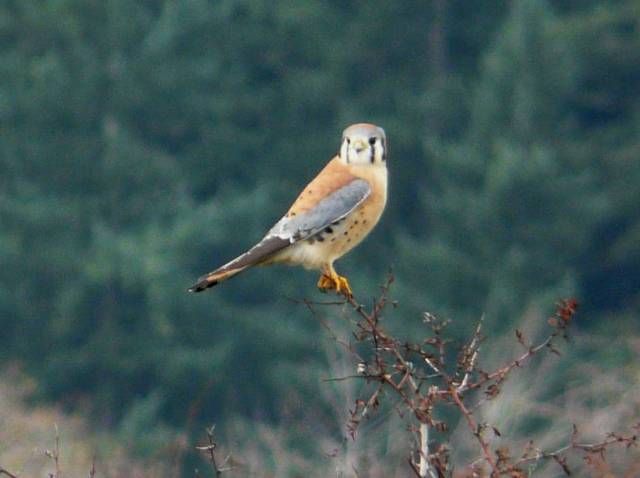
The open habitat is very attractive to raptors, like this American Kestrel. Northern Harriers and Red-tailed Hawks are also frequently seen.

I love to see these guys. Urban and suburban Coyotes are a songbird’s best friend. Studies have repeatedly shown that the presence of Coyotes coincides with larger populations of songbirds, since Coyotes reduce the number of free-roaming domestic cats. For more information on the effects of domestic cats on wildlife, check out the American Bird Conservancy site.
I combed the wigeon flocks at Portland’s Westmoreland Park and found examples of both species.
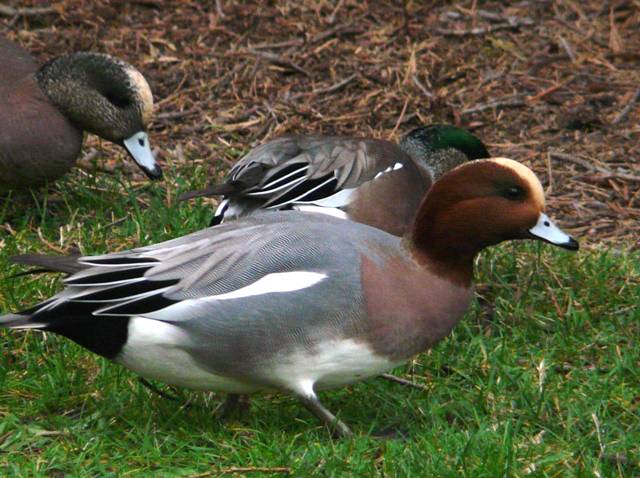
The bird in front is a male Eurasian Wigeon; the two in back are male American Wigeons. On the Eurasian, note the rusty head with the blond crown and the clear demarcation between the rose breast and gray sides.

another shot of the male Eurasian
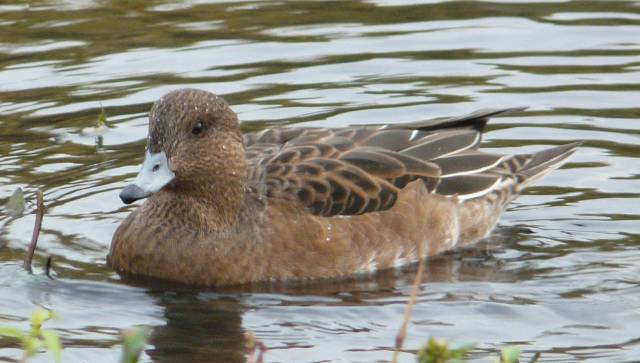
The female Eurasian Wigeon has a warm brown head that blends in with the breast. The markings on the head are diminshed in the throat area.
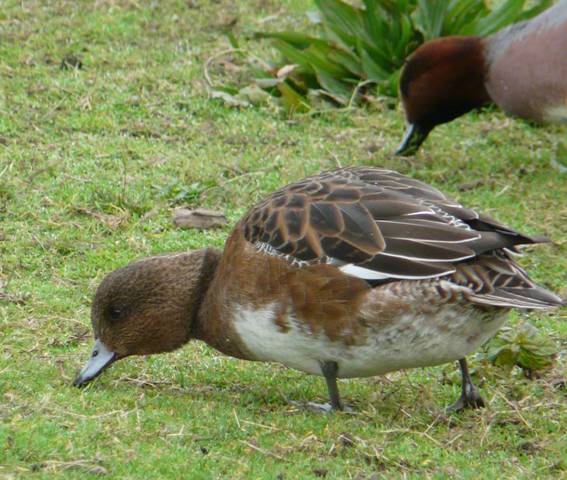
Here’s the female Eurasian Wigeon with the male in the background.

On a female American Wigeon, the gray head contrasts with the brown breast. The head markings remain bold in the throat area.

On some male American Wigeons, the cream color of the crown extends over much of the face.
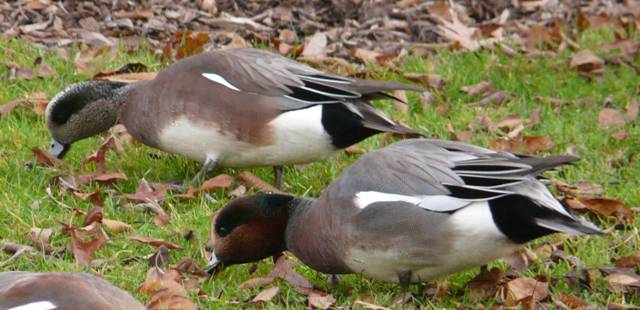
The bird in back is a typical male American Wigeon. The bird in front is a hybrid American X Eurasian Wigeon. The hybrid shows the rusty head coloring of a Eurasian with the green eye-stripe of an American. The bird’s sides show both rose and gray.

The same hybrid, showing an even blending of characteristics from both species.
I am revving up for my Little Brown Birds class next month, so I spent some time with the sparrow flocks on Sauvie Island (Birding Oregon p.57). A walk down Rentenaar Road revealed five species, three of which sat still long enough to be photographed.

White-crowned Sparrows stand out with their bold head pattern.

Immature White-crowned Sparrows have the same pattern as the adults, but in brown and buff instead of black and white.

Two Golden-crowned Sparrows, immature on the left, adult on the right
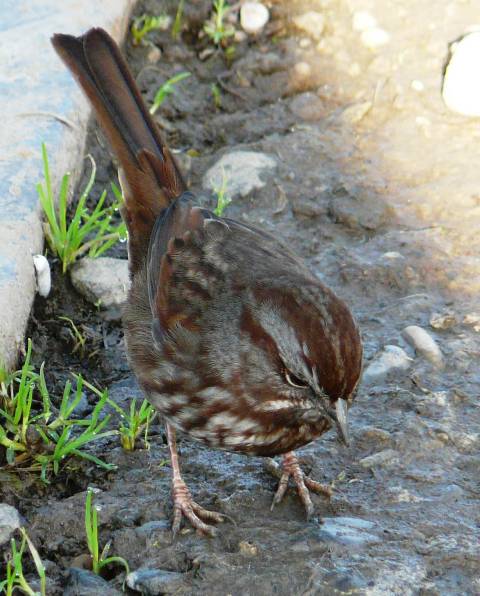
This Song Sparrow was feeding right at my feet, but insisted on staying in my shadow, thus messing up the lighting in the photo.
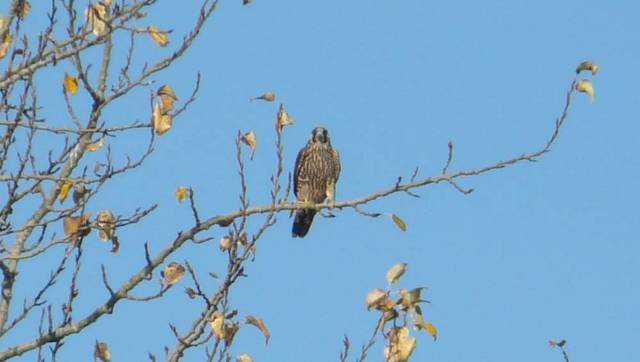
This Peregrine Falcon wasn’t much of a threat to the sparrows, but he did make the shorebirds and waterfowl nervous.
My birding has been limited lately, and walks in heavy cover under cloudy skies don’t produce many photo opportunities, but there is always something to see.

Final Score: Beaver: 1 Protective netting: 0

Licorice Ferns

Rough-skinned Newt, one of the most toxic animals in North America.

Eating one would be deadly to a human, but these animals are preyed upon by Common Garter Snakes.
 Ethical Birder