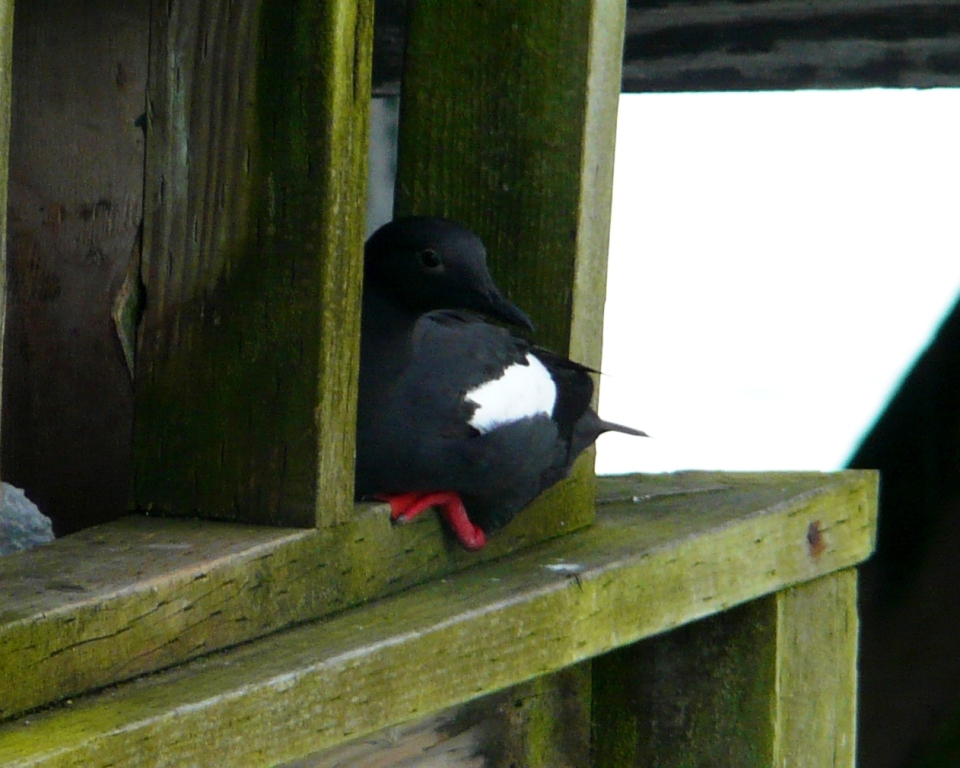
This Pigeon Guillemot was perched on the public dock in Garibaldi (Birding Oregon p.127). You have to love those red feet.
Klamath Basin
Here are some photos from a recent trip to the Klamath Basin.
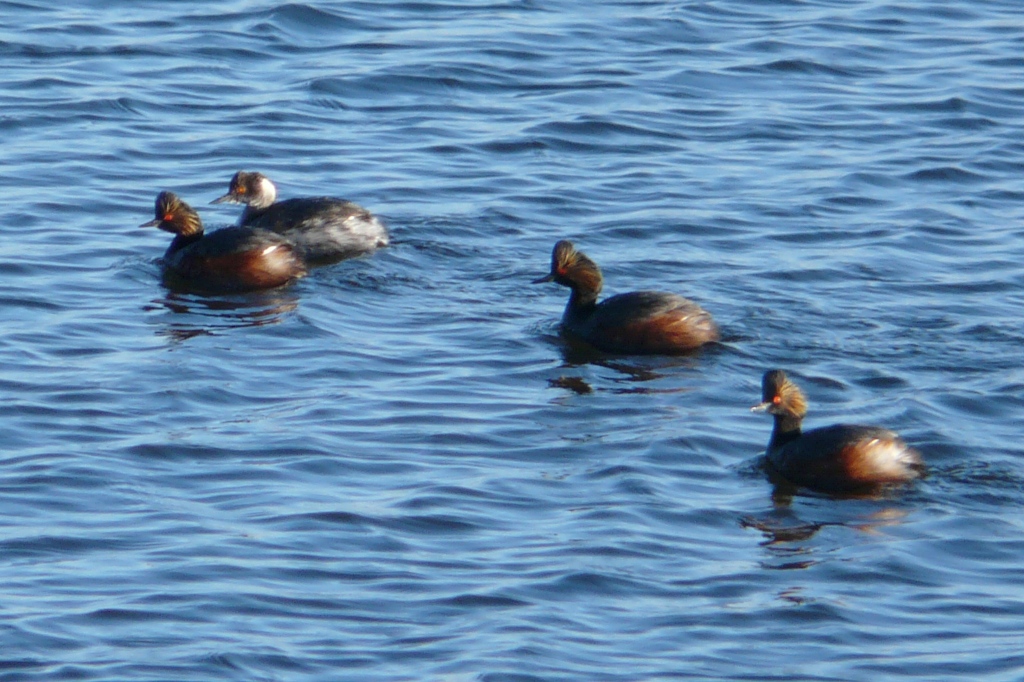
Eared Grebes are common in the wetlands along State Line Road (Birding Oregon p. 116). The second bird from the left is still in basic plumage, while all the other birds seen that day had already molted into alternate plumage.
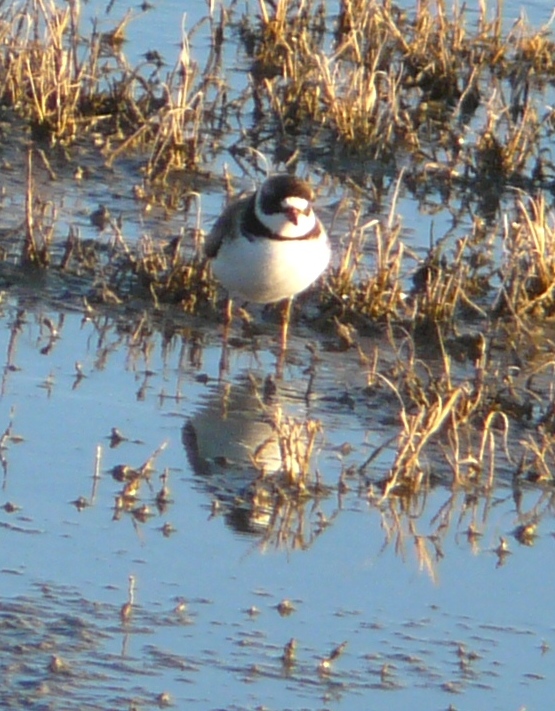
Shorebirds, such as this Semipalmated Plover, can be found on the mudflats along State Line Road.

This Pied-billed Grebe was nesting at Wood River Wetlands (Birding Oregon p.111).
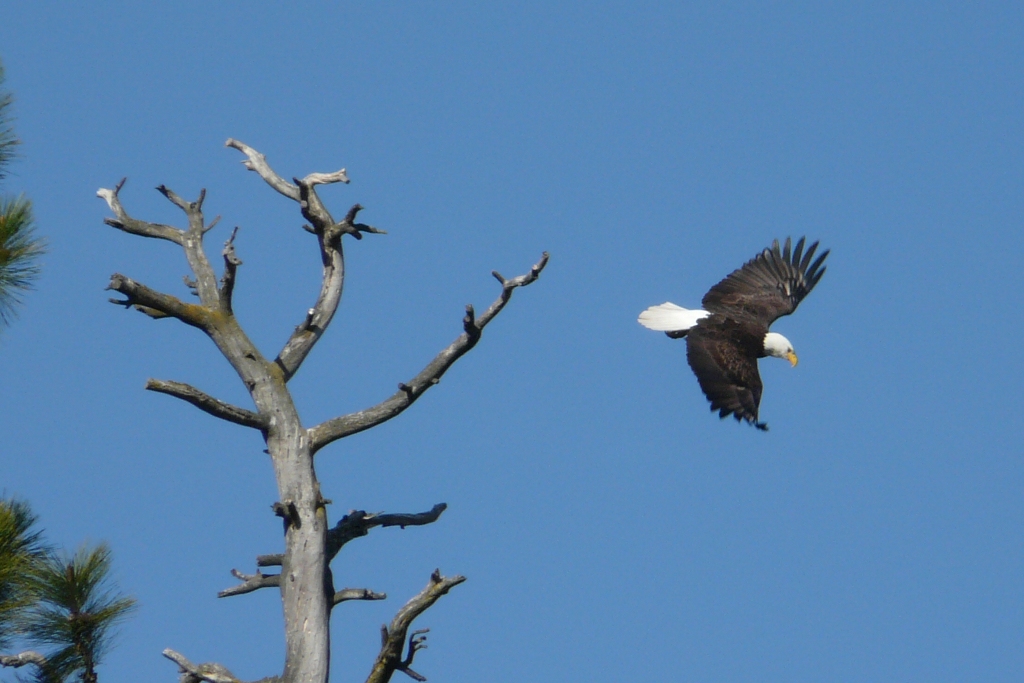
The Klamath Basin is famous for its large wintering population of Bald Eagles, but a few pairs stay to nest. This bird was found in Moore Park in Klamath Falls.

Moore Park is also home to Mule Deer. Note the fuzzy antlers starting to grow on the deer in the center of the photo.
Gray’s Harbor, WA
I’ve recently made two trips to Grays Harbor in Washington, once to scout and the other to lead my shorebird class. This estuary is a major staging area for migrating shorebirds in spring.
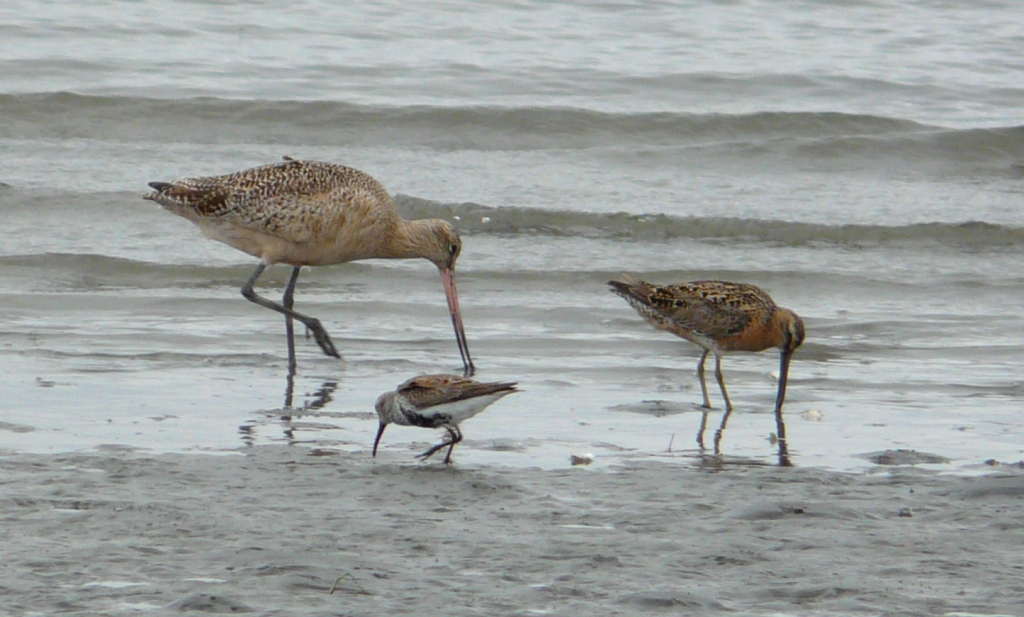
Marbled Godwit, Dunlin, and Short-billed Dowitcher feeding at Damon Point, near the mouth of the harbor
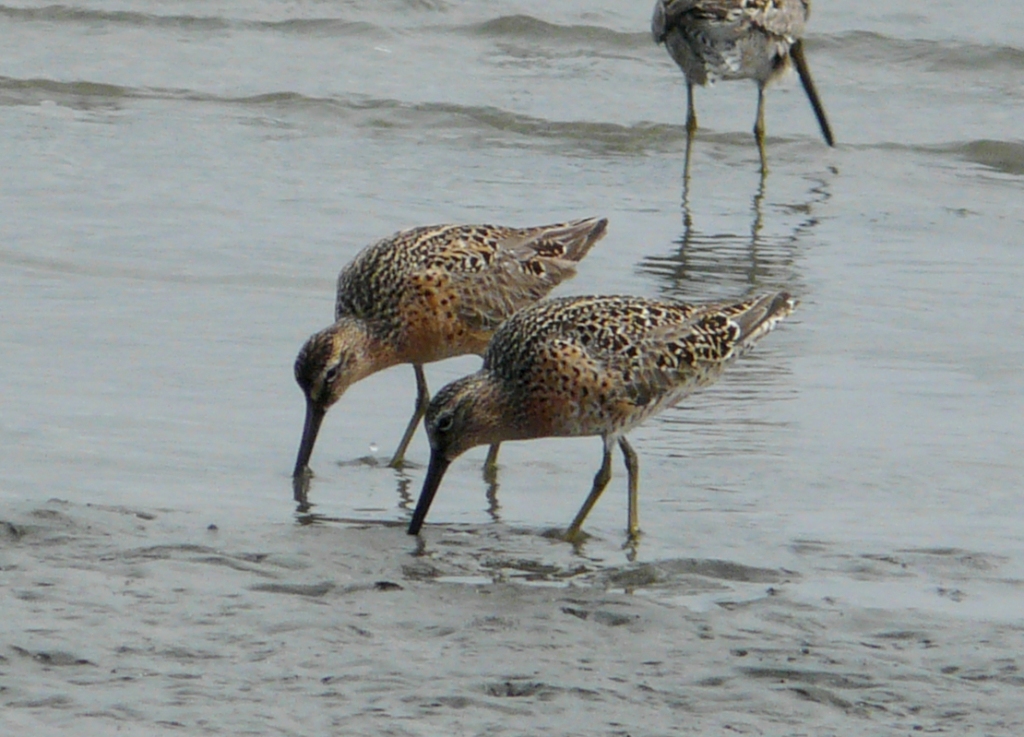
Short-billed Dowitchers

Don’t neglect to look at all the little brown ducks! This is a King Eider, a rare visitor from Alaska. It is distinguished from Common Eider by the slender bill and the scalloped markings on the sides.

Bowerman Basin is an inlet on the north shore of the harbor. It is the last area to fill during high tides, so shorebirds often congregate here. This is a view from the boardwalk.
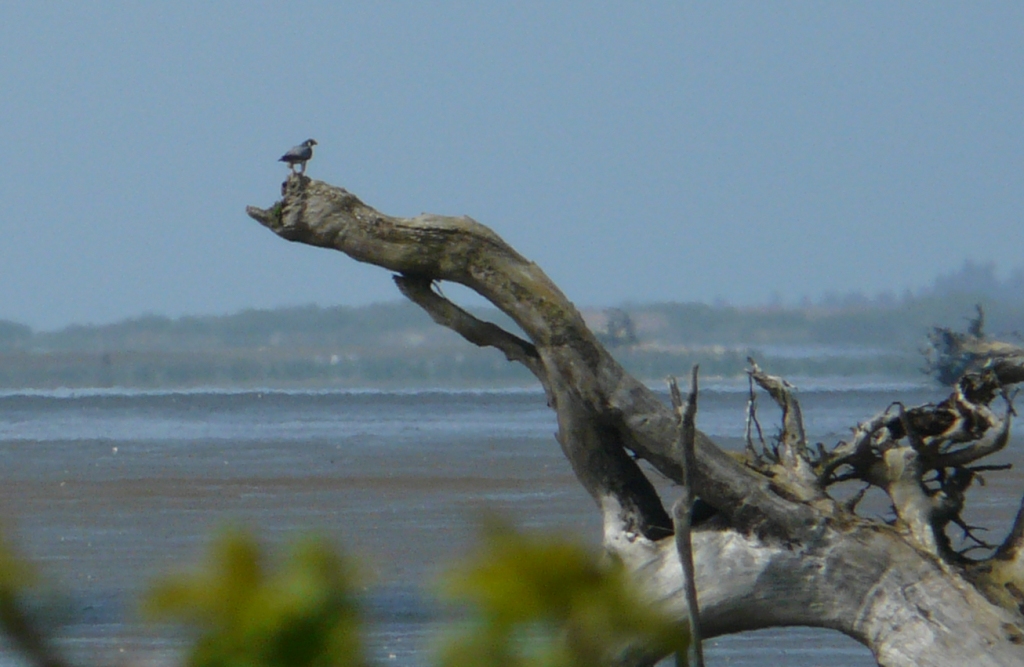
Peregrine Falcons are attracted by the large numbers of shorebirds in the harbor.

This is a view of the boardwalk on a Thursday morning.
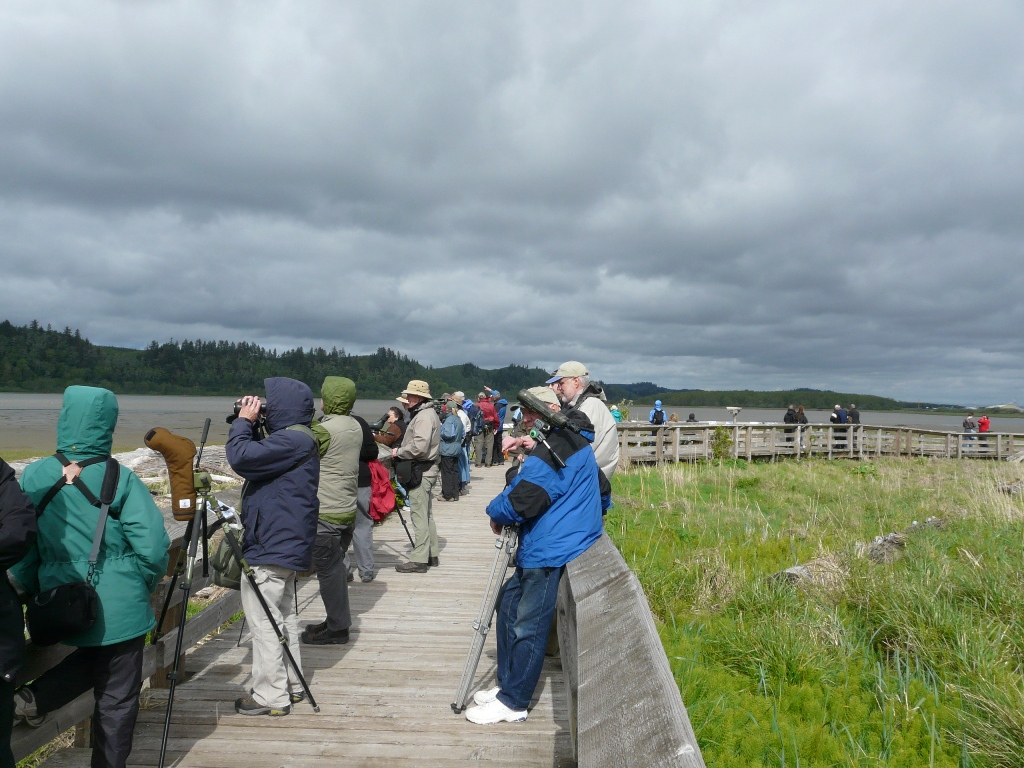
This is the boardwalk on a Saturday afternoon. Unfortunately, birders outnumbered birds by about five to one on this afternoon.
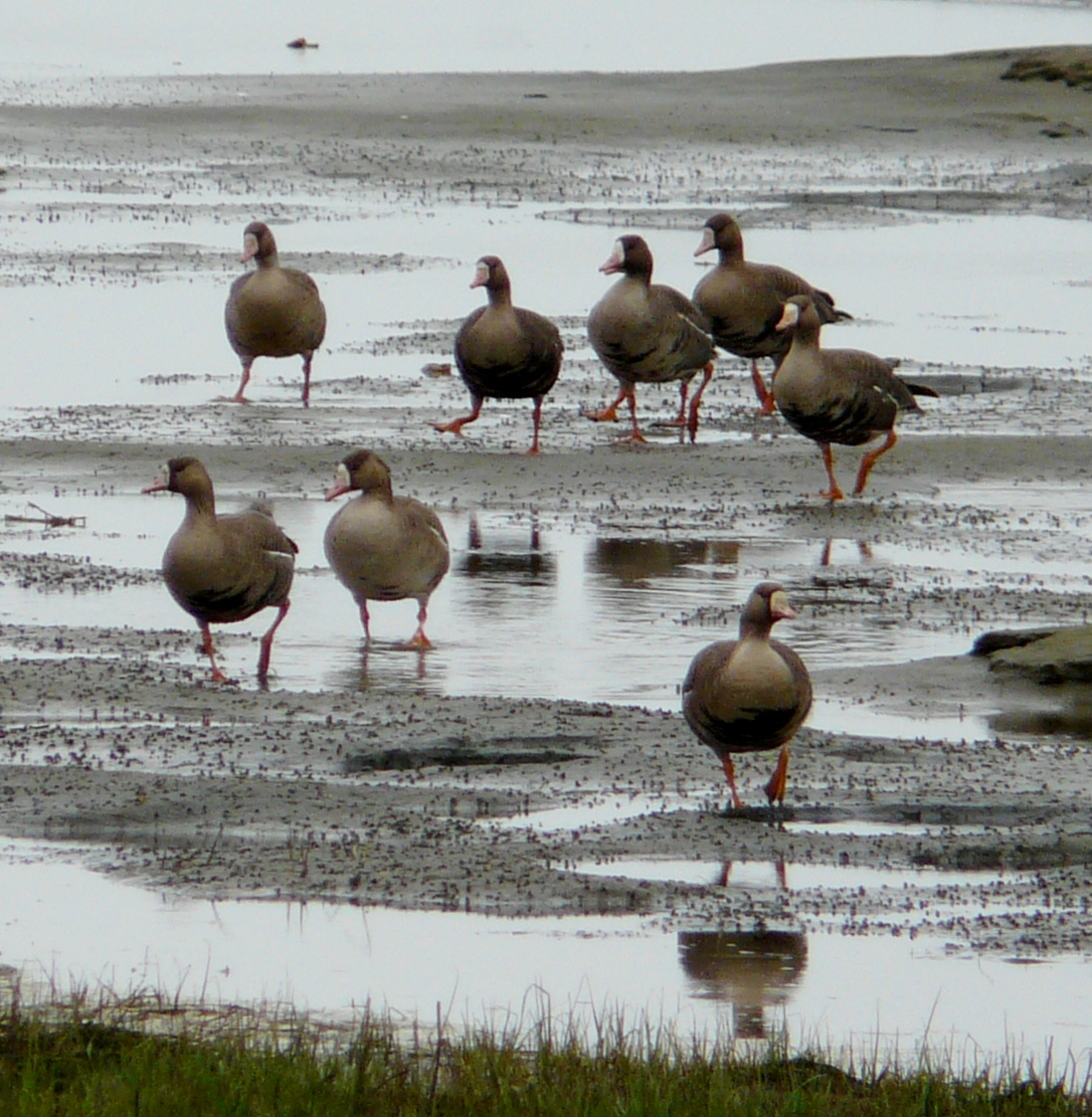
Greater White-fronted Geese
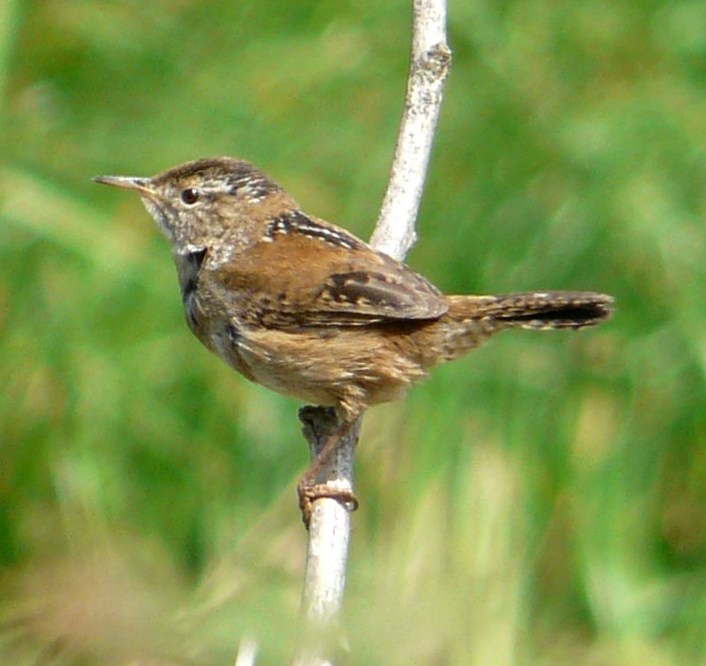
Marsh Wrens are common along the marshy edges of Bowerman Basin.
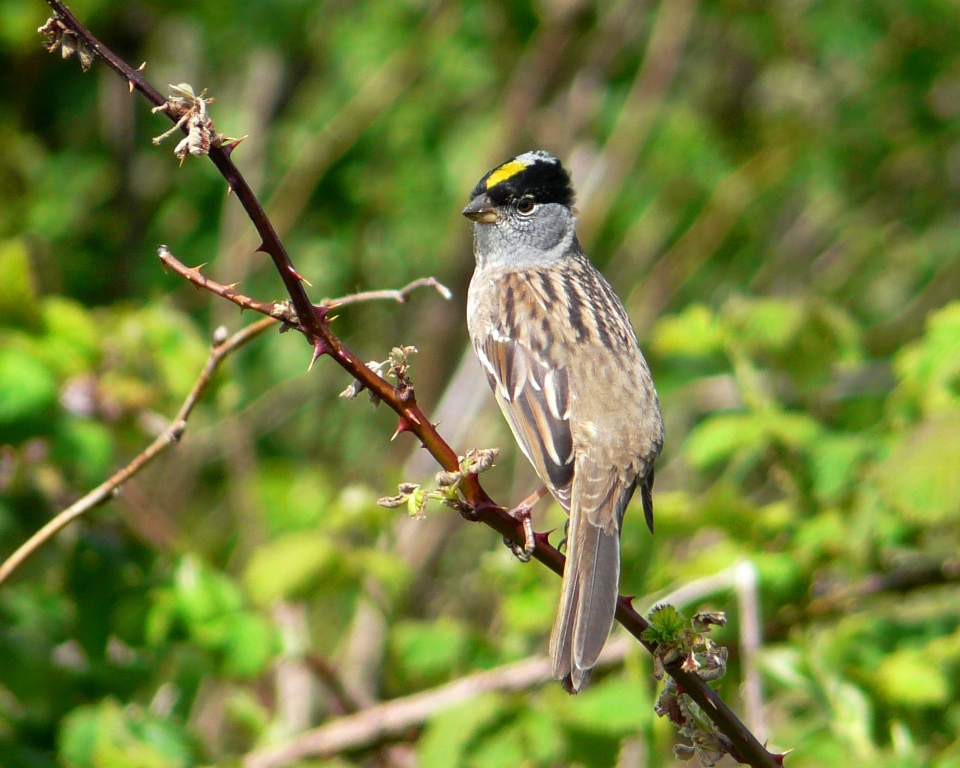
The willow thickets and woods along the boardwalk attract migrants like this Golden-crowned Sparrow.
Surf Scoter

Surf Scoters are common winter residents along the coast. They eat mollusks, usually caught by diving.

This individual was taking advantage of the low tide to find mollusks on an exposed piling.

Three Graces Tidal Area
The Three Graces Tidal Area (Birding Oregon p. 127) lies along the shore of Tillamook Bay, just south of the town of Barview. It is a small site, but the offshore rocks and rocky shoreline attract a nice variety of birds.
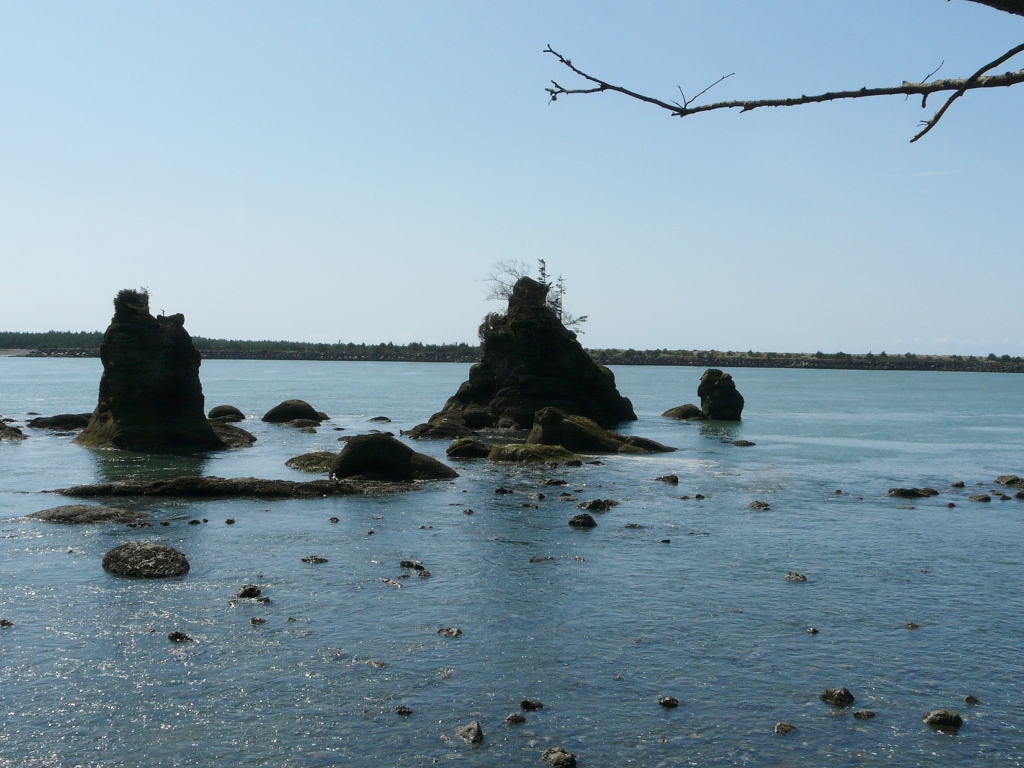
The best times to bird this site are in between high and low tides. When the tide is up, the small rocks are submerged. When the tide is too low, people sometimes walk out to the rocks, thus scaring the birds. Brown Pelicans, Common Loons, Harlequin Ducks, and other waterfowl are often seen swimming in the area. In winter, Rock Sandpipers and Surfbirds feed on the exposed rocks and shoreline.

Peer over the edge of the path to scan the shoreline for rockpipers and gulls. A scope is useful for checking the more distant offshore rocks.

A closer view of that distant rock. Pelagic, Brandt’s, and Double-crested Cormorants can all be found here, sometimes allowing side-by-side comparison. This photo shows mostly Pelagic Cormorants, with a possible young Double-crested on the right.
Sauvie Island
Here are a few recent shots from Sauvie Island (Birding Oregon p. 55).
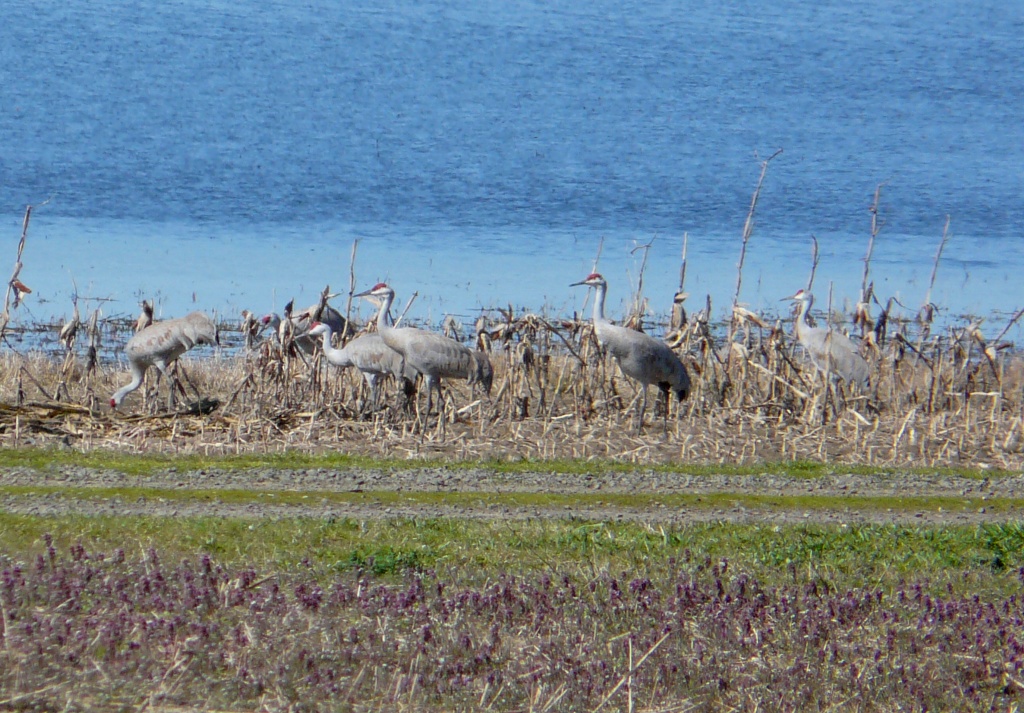
Sandhill Cranes are still present in good numbers.

Here are some Sandhills with three Dusky Canada Geese (Branta canadensis occidentalis). Note the red plastic collar on the goose on the far left. That is a quick way to identify this subspecies.
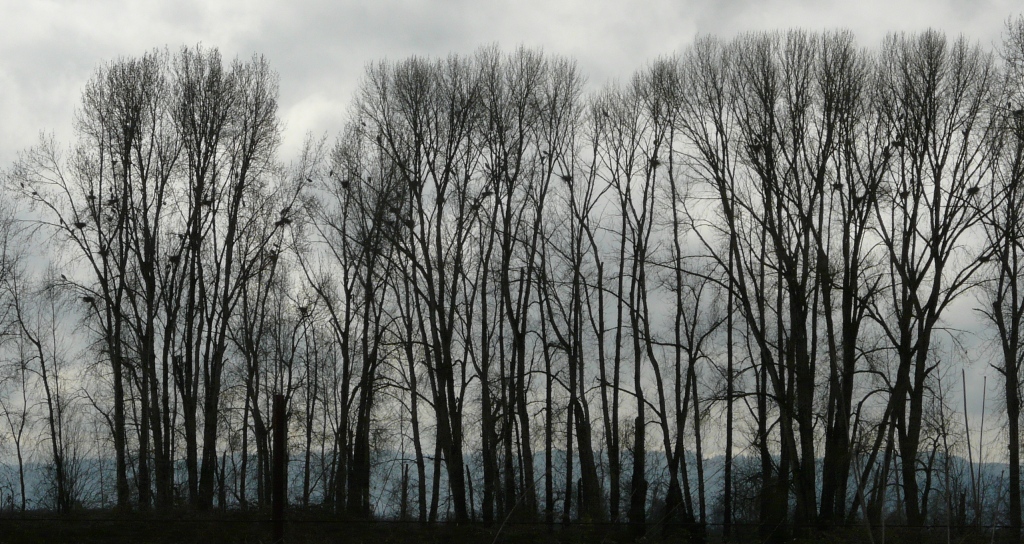
While the Sandhill Cranes and Dusky Canada Geese will fly to Alaska to nest, the Great Blue Herons are in full nesting mode now on Sauvie Island. Here is a section of a rookery in a distant tree line. You can see the bulky nests and, if you look closely, several birds perched in the branches.
Not Endangered Enough
The Department of the Interior recently announced that it would not be listing Greater Sage-Grouse as threatened or endangered, even though the bird, whose population has declined by at least 90 percent in the past century, “warranted” listing. This species joins a long list of birds and other wildlife that are in danger of extinction, but are not quite endangered enough to protect under The Endangered Species Act.
The problems revolve around money. First of all, if a species is listed under the Endangered Species Act, the Dept. of the Interior must develop and implement a recovery plan for that species. This takes a lot of money, and the department already has more species listed than it can afford to protect. Secondly, when a species is listed, that severely restricts the activities that can take place within that species’ habitat. In the case of Greater Sage-Grouse and other prairie birds, cattle ranching, oil and gas development, and wind power development are all limited, with substantial financial repercussions.
And so only those species who are the most critically endangered are listed for protection, and then a mad scramble begins to try to pull these species from the brink of extinction. Sometimes it is too late. In any case, it is much more difficult and expensive to try to save a tiny population than it is to protect a larger one.
So will this process continue as it has, or will we come up with a better plan? Will it get to the point where we will just have to let some species die out so resources can be channeled to other species that have a better chance? Maybe we will decide to work on saving large pieces of ecosystems, rather than concentrating on individual species.
In the meantime, a growing list of species continues on the path to extinction, waiting to reach that critically endangered point where drastic measures will be taken to keep the species from disappearing completely. One of my favorite birds, Lesser Prairie-Chicken, is on that path. Their population is about five percent of what it was, and continues to drop. Their numbers are a small fraction of that of Greater Sage-Grouse, but the species continues to be denied protection under the Endangered Species Act. Their time of listing may be coming, but I fear it will be too late.
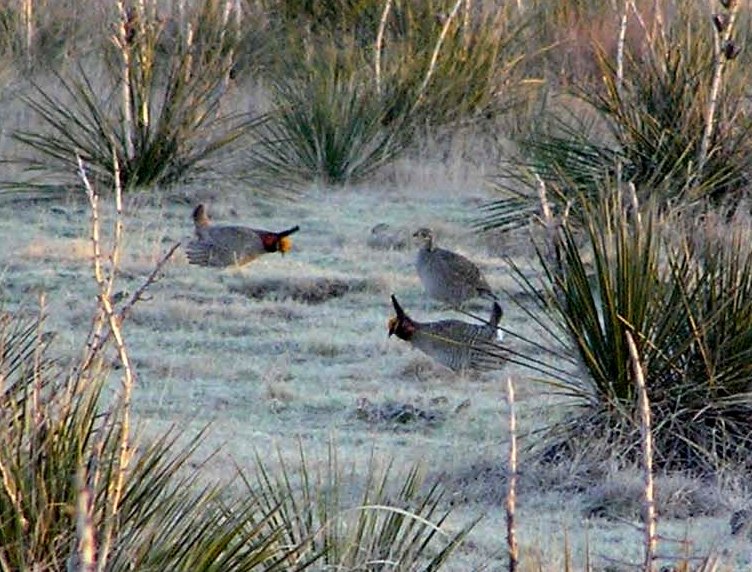
Lesser Prairie-Chickens, Morton Co., KS 2007
Random Waterfowl
Here are some random shots of some of the many waterfowl species that winter in the Willamette Valley
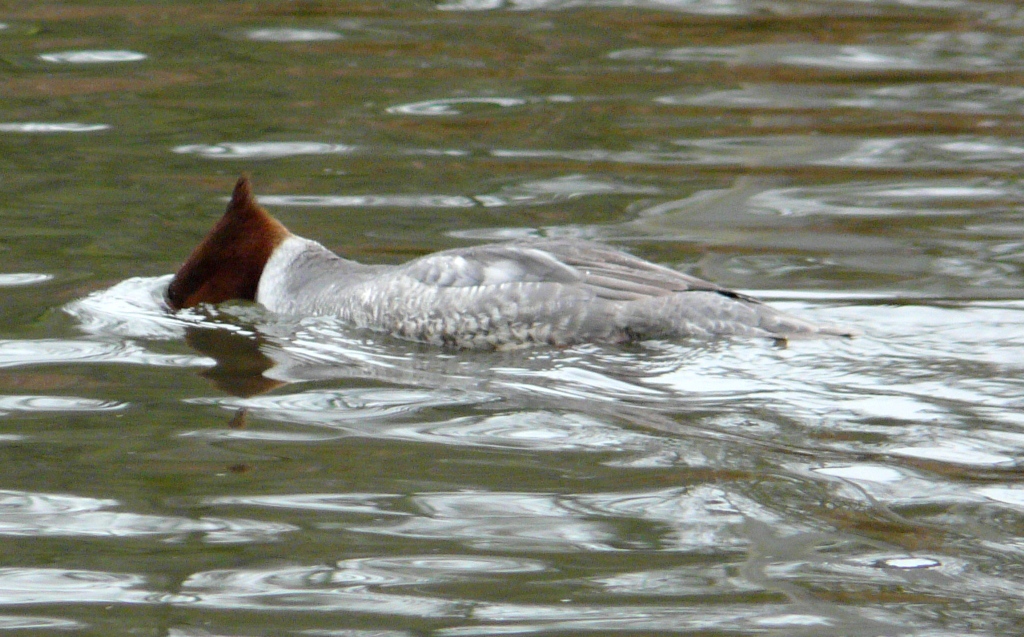
This Common Merganser was swimming with her face submerged, looking for fish. I have also seen loons hunt in this way.
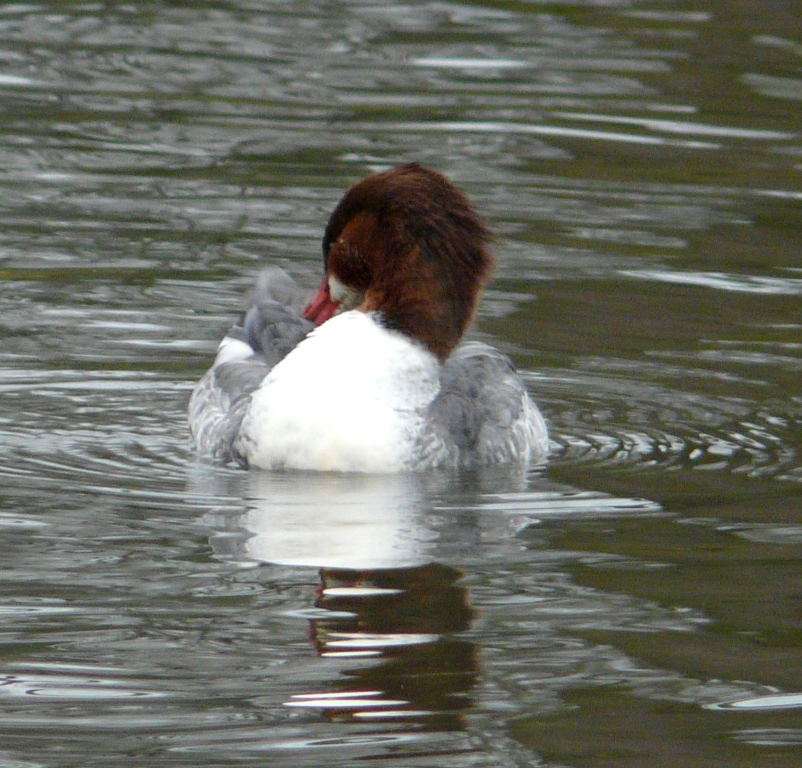
the same bird preening

Here she finally shows her face. The clearly demarcated white chin helps to differentiate this species from the similar Red-breasted Merganser.

This female Eurasian Wigeon is recognized by her brown head. Notice the female American Wigeon on the right with her gray head.

Here is a distant shot of a mixed flock of waterfowl (click to enlarge). From left to right, you can see Ring-necked Duck, Canvasback, Cackling Goose, American Coot, and American Wigeon.
Mew Gull
A large flock of Mew Gulls (Larus canus) spends the winter at the waste water treatment plant in Forest Grove and at adjacent Fernhill Wetlands (Birding Oregon p. 61).
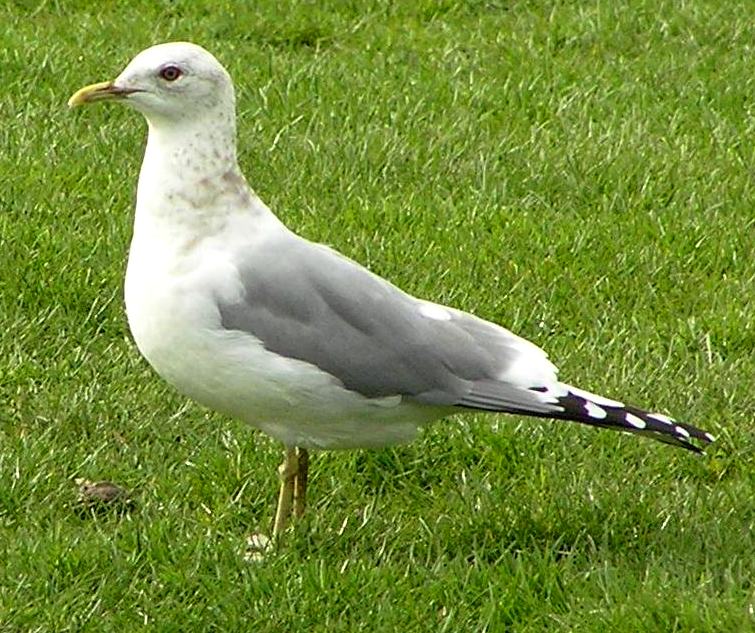
Mew Gulls look like a petite version of Ring-billed Gulls, with a round head, big eyes, and fine yellow bill.

Adult Mew Gulls are easily recognized in flight by the large white mirrors on the outer two primaries. Ring-billed Gulls have a smaller white mirror on the outermost primary (P10) and a tiny one on P9. You wouldn’t think the size of the white spots on two feathers would make much of a difference in identifying a flying bird, but it really does.
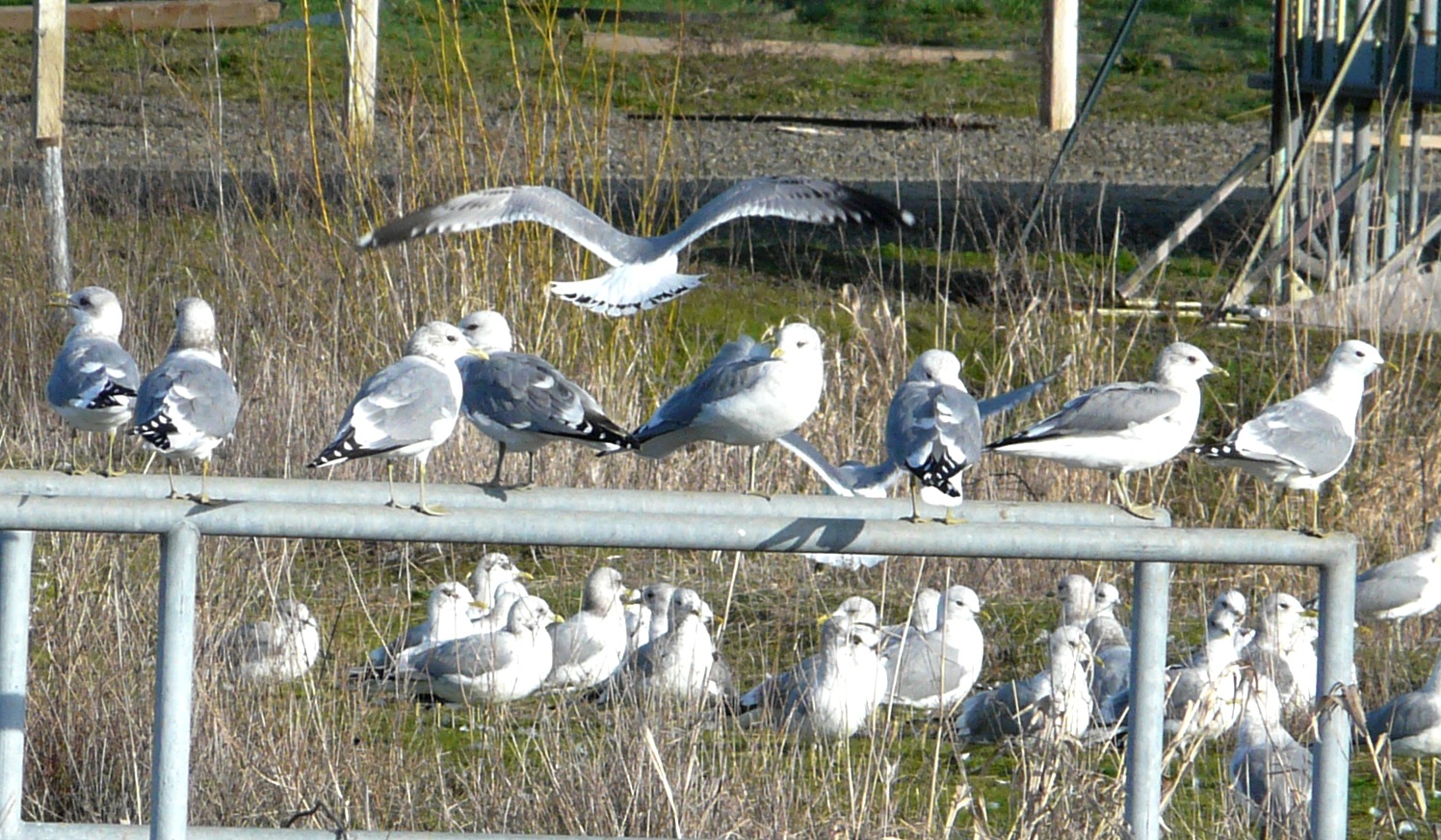
The bird in flight is a second-cycle Mew. He/she has lost the brown plumage of a first-cycle bird, but the tail still shows a broken blackish band, and the primaries (and primary coverts) have more black than those of an adult. Notice the small white mirror on P10 and little or no white on P9.
Ring-billed Gull
Ring-billed Gulls (Larus delawarensis) are common winter visitors throughout western Oregon. They prefer fresh water environments, so you find them more often at inland sites and in estuaries than you do on the beach. They breed in eastern Oregon and along the Columbia River.

This is a first cycle Ring-billed. Unlike the larger species that take four years to reach maturity, Ring-billed Gulls are a three-year gull, so first cycle birds already show gray on the mantle. Note how far the wing-tips extend beyond the tail.

First cycle Ring-billed Gull

This is a typical adult Ring-billed Gull showing the clear dark band on the bill, which gives the species its name. Note the yellow legs, pale iris, and the fine streaking on the head in winter.

This individual has unusually heavy markings on the face and crown.

At close range you can see the red orbital ring and some red at the gape.
 Ethical Birder