Sauvie Island

I spent a gorgeous day at Sauvie Island, northwest of Portland. There are still good numbers of waterfowl and Sandhill Cranes, but the sparrows have started to thin out.

sandhills.jpg
Sandhill Cranes (and Mallards)

dusky-sandhills.jpg
Dusky Canada Geese, Sandhill Cranes (and Mallards)

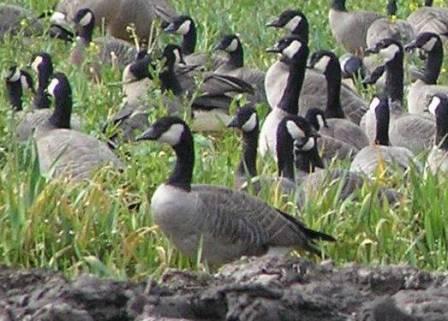
lesser.jpg
I believe the front bird is a Lesser Canada Goose. The bill is long and slopes gently into the forehead, unlike the stubby bills and rounded foreheads seen on Cackling and Taverner’s Cackling Geese.

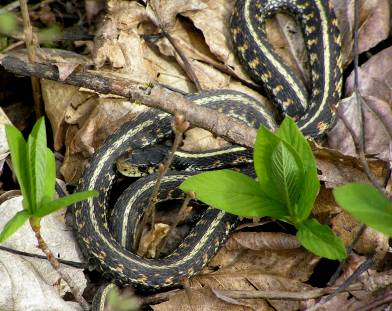
garter.jpg
I saw at least a dozen Garter Snakes around Wapato Access Greenway. This was one of two that sat still long enough for photos.

Cackling and Canada Geese

My current birding project is studying the various races of Cackling and Canada Geese (Branta hutchinsii and Branta canadensis). Canada Goose was split into these two species in 2004. There are multiple races of each, so it is a good idea to become familiar with all the different forms in case more splits occur. If nothing else, it adds a bit of a challenge when confronted with a large congregation of geese.

In the Pacific Northwest, there are four races of Canada Goose (Western, Vancouver, Dusky, and Lesser) and three races of Cackling Goose (Taverner’s, Aleutian, and Cackling). The greatest identification challenge seems to be differentiating between Lesser Canada Goose and Taverner’s Cackling Goose. The two overlap in size and color, and different sources give conflicting information about their characteristics. The best field mark on close birds seems to be the shape and relative length of the bills; short and steep on Taverner’s, longer and more sloping on Lesser Canada.

Here are a few websites that you may find helpful in learning the various races of white-cheeked geese.
http://sibleyguides.com/canada_cackling.htm David Sibley’s notes that were written just after the species were split. Good information, but not complete, especially regarding the Lesser Canada/Taverner’s Cackling issue.

http://www.idahobirds.net/identification/white-cheeked/subspecies.htm Harry Krueger’s site. This is a work in progress, but it offers great information on several subspecies.

http://www.dfw.state.or.us/resources/hunting/waterfowl/goose-permits/Goosefieldguide_2ndEdition_final.pdf This 83-page publication from the Oregon Department of Fish and Wildlife is a wealth of information and photographs. Be warned; this publication is intended for hunter education, so some of the photos are of “harvested” birds.

geese.jpg
Cackling Cackling Goose (top) and possible Lesser Canada Goose
Pacific City

I spoke at the annual Birds and Blues Festival last Saturday in Pacific City, OR. Our hotel room had a lovely view of Haystack Rock. (There is another Haystack Rock at Cannon Beach, but the residents of Pacific City refer to that one as “the small one.”)
haystack-rock.jpg

The area around Pacific City is the only winter home of the Semidi Islands Aleutian Cackling Goose. The birds spend the day grazing in short pastures, and at night roost on the ocean near Haystack Rock. In the morning, you can watch the birds take off in small flocks as they head out to feed. There is something special about being able to sit on your balcony and see every member of a distinct population of bird. But it is also very frightening to realize that one storm or one oil spill could wipe out the entire population.
geeserock.jpg

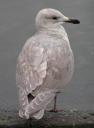
This Thayer’s Gull chose to nap in the middle of a parking lot.
sleepy-thayers.jpg

What a difference a day makes

Last Friday I went to Sauvie Island to scout out locations for my class field trip on Saturday. The birding was great, not only for sparrows (which was the topic of the class) but for other birds as well. Along Rentenaar Road I found large flocks of White-crowned and Golden-crowned Sparrows, several Lincoln’s Sparrows and a Fox Sparrow. More unusual were three Common Ravens, a dark-morph Rough-legged Hawk, and a pair of Pileated Woodpeckers flying over the farm fields. California Quail were calling from the blackberry thickets along the road.

The following morning, with my class in tow, I walked the same stretch of road. The White-crowned flock was much smaller. We saw only one distant Lincoln’s. The ravens, Rough-legged, and Pileateds were nowhere to be seen, and the California Quail called from way back in the fields. But we did find a White-throated Sparrow, a Peregrine Falcon, and a Red-breasted Sapsucker, which I hadn’t seen the day before.

This brings up an obvious, but often forgotten tenet of birding: Those who find the greatest diversity of species and the most rarities are those that spend the most time in the field. If it seems like other birders are finding a lot more birds than you are, take a look at how often you actually go birding. Successful birding is not entirely dependent on skill and experience. Sometimes it is just a matter of getting out to where the birds are.

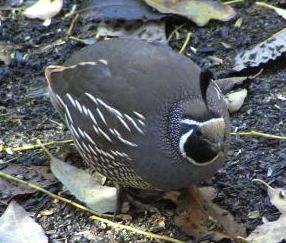
ca-quail.jpg
California Quail

Sick Siskins

This has been a good winter for Pine Siskins at the feeders. Unfortunately, when you have large flocks of siskins, it is not uncommon to find sick individuals. These birds are susceptible to both respiratory and eye diseases, both of which can be transmitted to other birds through close contact. It is important to keep your feeders clean and remove debris from underneath on a regular basis. If you see more than a few sick birds, take the feeders down for a couple of weeks so the birds will disperse.

In this photo, the sick individual stands out by being much more “fluffy” than the other birds. Sick birds will also be lethargic, sometimes going to sleep at the feeder.
sick-siskin.jpg

Into the Woods

I did a little birding in Portland’s Forest Park yesterday. I live on an ash swale, so it is nice to get out into an actual coniferous forest, the type of habitat that the Pacific Northwest is known for. Among the many Ruby-crowned and Golden-crowned Kinglets were a pair of Varied Thrushes, several Winter Wrens, a Brown Creeper, and a flock of Chestnut-backed Chickadees. My camera is a simple point-and-shoot, hardly suitable for small, fast-moving targets. But I like the way this photo turned out. The bird’s face is in focus (close anyway) while the rest of the bird is a blur of activity. A very fitting portrait of this frenetic species.
Chestnut-backed Chickadee

Banded Chickadee

While birding at Smith and Bybee Wetlands in north Portland on January 31, I found a Black-capped Chickadee wearing four leg bands. Her right leg held two blue bands, while the left had a blue band over a silver band. A request for information to the Oregon birding email list produced a quick response from the bander, Phil Gaddis. I learned that this bird was a female that had been banded on April 27, 2007, just a few yards from the spot where I found her.

I was lucky that the researcher who banded this bird happened to be on the Oregon birds email list. But there is a website where you can report banded or color-marked birds. The Patuxant Wildlife Research Center keeps records of all federally licensed bird banding operations. If you have the bird in hand and can read the numbers on a metal band, that is the easiest and fastest way to find out about that individual bird. But you can also report color-marked birds, such as my chickadee, and the staff at Patuxant will probably be able to track down the researcher that is using those color codes.

So keep your eyes open for marked birds. If you find a dead bird, check for a leg band. The information is vital for bird research, and it is fun to find out where your bird has been.

Answers to 2nd cycle gull quiz

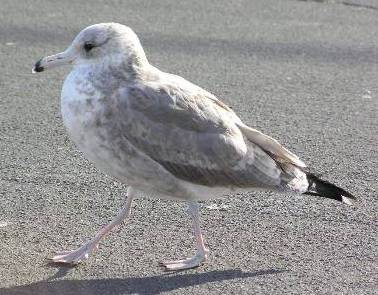
california2.jpg California Gull
The first impression you get of this bird is its long lean look. The bill is long and thin, with a distinct dark band near the tip. The body is fairly slender and the dark wings appear very long. Despite the strong light in this photo, you can still make out the bluish gray color on the joints of the yellowish legs.

western2.jpg Western Gull
Two words: Bulky and Dark. The bill is very thick. Although shades of gray are very hard to judge in photos, the mantle color of this bird seems pretty dark. The tertials are blackish. The primaries and tail are black. This much contrast on a large pink-footed gull points toward Western.

glaucouswinged2.jpg Glaucous-winged Gull
Like the other age classes of Glaucous -winged Gull, this bird shows a general lack of contrast. The mantle is a little gray, the primaries are a little brown, but everything on this bird blends together really well. A Glaucous Gull would show lighter primaries, while a Western hybrid would show much darker.

2nd cycle gulls

Since I am still in “gull mode” from my class at Portland Audubon, here is another gull quiz. These three birds are in their second plumage cycle; still pretty brown and blotchy, but with some gray coming in on the mantle. All three were photographed in Oregon in autumn. Don’t worry. Pretty soon migration will pick up and my attentions will be drawn to other birds.

california2.jpg
Number 1

western2.jpg
Number 2

glaucouswinged2.jpg
Number 3

A Deluge of Dunlin

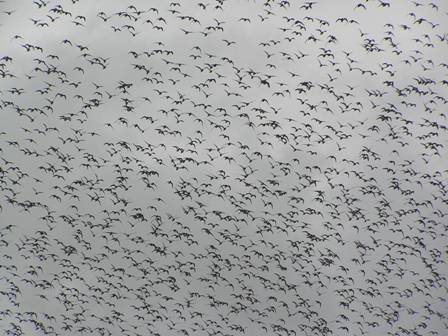
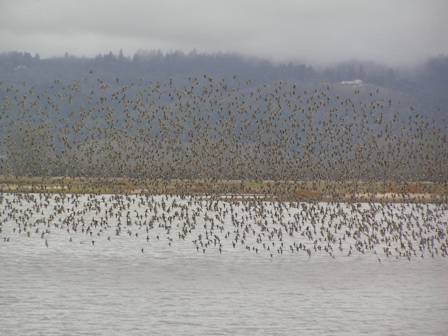
Here are a few photos of a flock of Dunlin at Ankeny NWR. I’m guessing the flock consisted of around 500 individuals. They circled in tight formation over the water for at least a half hour. When the flock turned, their wings made a roaring sound. Great fun. I don’t know why they did this for so long. There was no predator visible, and several birds were resting on the shore while the flock was carrying on. Perhaps getting in shape for migration?

dunlin1.jpg

dunlin2.jpg

dunlin3.jpg