Warbler Neck

In the current issue of Bird Watcher’s Digest, I have a piece on warbler neck, that stiffness and pain we get from looking into the treetops for too long. While some fatigue is inevitable after a long day in the field, our birding posture can prevent most of the discomfort and long-term damage associated with warbler neck. The article goes into greater detail, but here are two photos showing typical bad posture (left) and good posture (right).

In the left photo, notice how the shoulders are hunched up and the neck is bent back sharply. This leads to fatigue and excessive wear on the cervical vertebrae. This is my wife, Marsha, posing for this photo. Her posture is normally quite good, so it took a lot of posing on my part to get her this scrunched up.
In the right photo, the shoulders are down and the neck is gently sloping back. The body forms a single gentle arch from the head to the feet with no sharp kinks in between. This is Lauri Elizabeth, an instructor of The Alexander Technique, a method of movement and body alignment. I always sit up straighter when she is around.

Credibility, Skepticism, and Chasing

A recent report on Oregon Birders Online of a Magnificent Frigatebird along the Columbia River set off a series of messages questioning the accuracy of the identification. This, in turn, triggered even more messages, some highlighting the birding credentials of the person who made the initial report, some criticizing those birders who simply dismiss reports of rarities from birders they don’t know, and some describing how objective skepticism of birding reports is a good thing.

It all boils down to this: How do you know if a report is credible? How skeptical should you be? How convincing does a report have to be before you will chase the bird being reported? Each birder will answer these questions differently. Some require irrefutable evidence, such as a clear photo or multiple expert witnesses, before accepting a report of a rarity. Others will assume the report is accurate until it is proven otherwise. Wherever you lie on this continuum, here are some things to consider.

1. Rare birds are attracted to inexperienced birders. Newbies find a lot of great birds, partly because they look at every bird carefully, and partly because of dumb luck. Just because a birder has not established a reputation, don’t assume they haven’t found what they say they found. Of course, a lot of new birders make mistakes, but why risk letting a rarity go unconfirmed? That Hoary Redpoll your neighbor reports from their feeder may turn out to be a House Finch, but maybe it’s actually a Hoary Redpoll.

2. Even experienced birders make mistakes on occasion. Experience can lend credibility to a report, but it is not a guarantee.

As far as chasing goes, that is also a personal call. Some people will fly across the continent for a good bird. I generally don’t travel more than 90 minutes from home to chase an individual bird, and I usually like verification of the report before traveling that far. But if you are able, why not check it out? You may get to see a great bird, find a different rarity in the process, or at the very least enjoy a day in the field.

As for reporting a rarity, do it. Don’t be afraid of being wrong or embarrassed. You will either provide an important record of a rare bird for your area, or someone will explain your error and you will learn something.
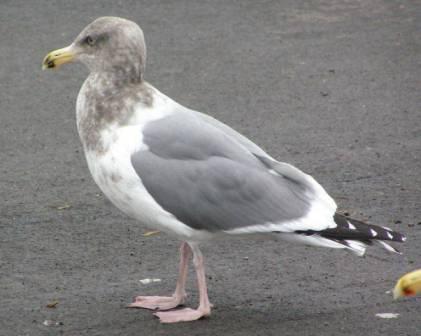

This beast led to an embarrassing mis-identification on my part. But it also led to discussion, and greatly advanced my study of gull identification.
Sitting in Seattle

Marsha was working a table at the Seattle Greenfest last weekend, so I braved the traffic and found my way to Discovery Park. I walked out to the lighthouse and just sat on the shore of Puget Sound for a while. As a birder, I need to spend a lot more time sitting. Most of us are constantly moving, looking for the next good bird. But if you just sit in one place, good birds will often come to you. Out on the water were a big flock of Western Grebes, Horned Grebes, Ruddy Ducks, Harlequin Ducks, and a pair of Rhinoceros Auklets. These birds were out of camera range, but several species came in for closer scrutiny.


A flock of Black Brant were working the shoreline.


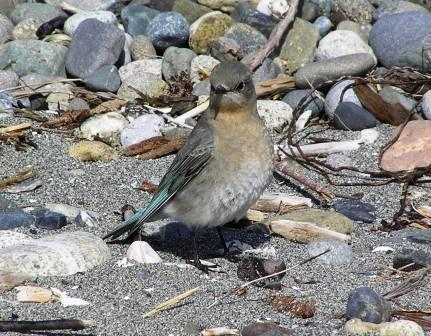
This Mountain Bluebird seemed a little out of place on the beach.


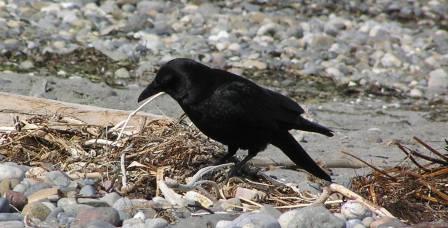
This crow found and ate a small crab. A little over a century ago, a crow on the coast of Puget Sound would have been assumed to be a Northwestern Crow. But when the forests were cleared, American Crows were able to colonize this area. So now, the crows around Seattle are presumed to be American or hybrids.


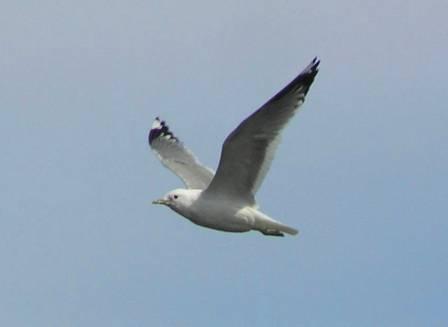
Mew Gull. Note the thin bill and large white mirrors on P1 and P2.


Red-necked Grebe

Lesser Goldfinch

Five years ago, it would have been an unusual treat to find a Lesser Goldfinch at my feeders. But in recent years, this species has expanded its range in the Portland area and now nests on our property. A large flock of American Goldfinches and Pine Siskins still crowds the feeders, but the Lessers assert themselves quite well. Soon the Americans and siskins will leave and the Lessers will have the nyger feed to themselves.


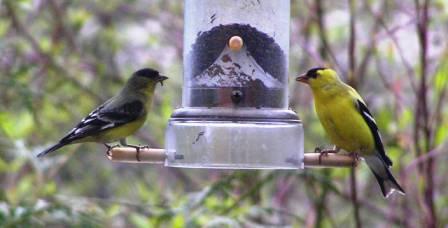
Lesser and American Goldfinches

Sabal Palm Audubon Center to be fenced off?

The New York Times ran an article on the Sabal Palm Audubon Center in Brownsville, TX. There is a frightening chance that a border fence may be built north of the sanctuary, thus shutting off access to one of the most famous birding hot-spots in the U.S., and in effect ceding that 500+ acres to Mexico. While some argue that we need a fence to protect us from the illegal housekeeping and lawn care specialists invading our country from Mexico, I hope clearer heads will prevail and stop this project. The tropical palm forest ecosystem is one of the rarest in the country, and really can’t tolerate a major construction project like this fence. As a birder, my feathers get very ruffled at the prospect of being fenced out of one of the more important bird sanctuaries in my own country.

Here are some photos I took at Sabal Palm in April of 2007. I hope we all have the opportunity to visit this place in the future.
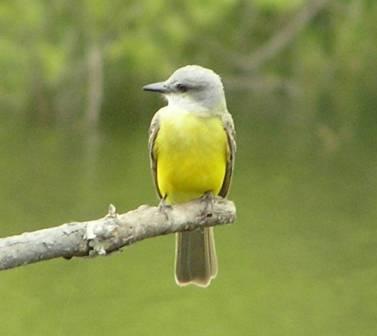
Couch's Kingbird
Couch’s Kingbird


Plain Chachalacas and White-tipped Doves


Neotropic Cormorant


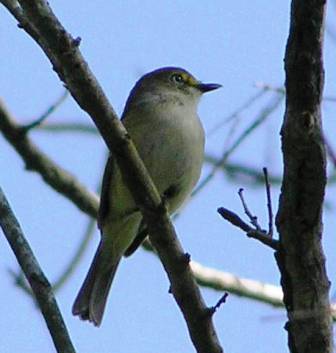
White-eyed Vireo

Sauvie Island

Some lovely weather at last. I walked along Rentenaar Road on Sauvie Island today. Many of the geese have moved on, but there were still a few good flocks of Cackling Geese and Sandhill Cranes.

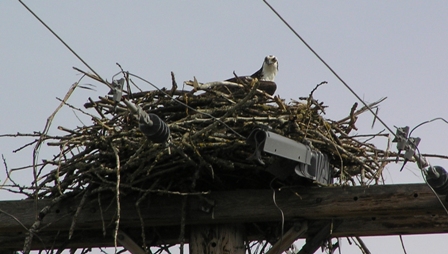
osprey-nest.jpg
A pair of Ospreys are working on a nest. There is a platform built for them just a few yards from this spot, but these birds prefer to build on the power lines.

osprey.jpg
This individual was eating a fish while the other tended the nest.

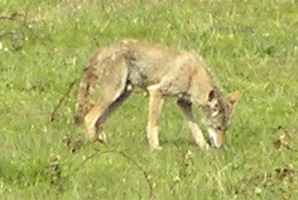
Two Coyotes were sniffing around in a pasture. I never get tired of watching these guys.
coyote.jpg coyote2.jpg

Smith and Bybee Wetlands

Spring continued to elude us today, with heavy snow showers this morning and temperatures that never made it above the low 40s. At Smith and Bybee Wetlands, Tree and Violet-green Swallows were hunting right at the surface of the water. This picture shows a squall of pea-sized hail moving over Bybee Lake. I don’t know how the birds found anything to eat in such weather.
squall.jpg

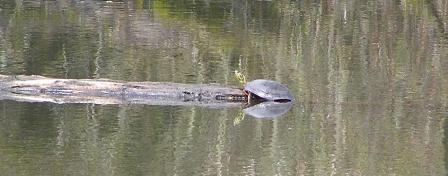
The woods held good numbers of Yellow-rumped Warblers; all those I saw well were of the Myrtle race. A few Lincoln’s Sparrows, Ruby-crowned and Golden-crowned Kinglets, Bewick’s and Marsh Wrens, Bushtits, Black-capped Chickadees, and a Brown Creeper rounded out the songbird sightings. The sun did peek out between squalls, and this drew a few Western Painted Turtles out to bask briefly, despite the cold temps.
painted-turtle.jpg

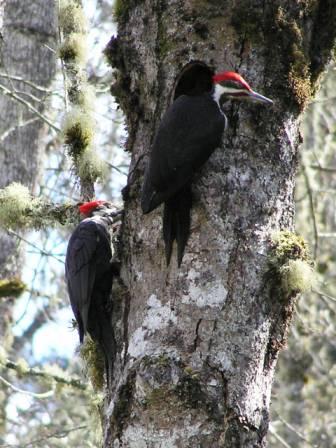
Pileated Woodpeckers excavating

Our warm spring weather has deteriorated into windy, cold, rain-and-snow-mixed squalls. Such weather brings on cabin fever rather quickly. So in an effort to avoid total psychosis, I bundled up and headed for Tualatin Hills Nature Park in Beaverton. Aside from the cheery singing from both Bewick’s and Winter Wrens, the highlight of the trip was a pair of Pileated Woodpeckers excavating a nest cavity.

pileated-male.jpg
I first saw the male, pecking away inside the cavity and occasionally hauling out a clump of chips in his bill

pileated-pair.jpg
The female soon joined the male, and did a little excavating after he flew off.

pileated-cavity.jpg
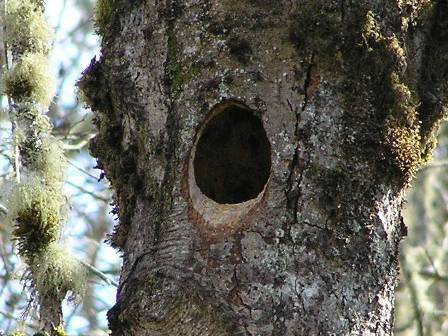
Here is the cavity. Notice how the lower edge is beveled, just like the cavities of Black-backed and American Three-toed Woodpeckers. The oval shape, and the lack of other excavation nearby, suggests this is a nesting cavity. Cavities produced by feeding Pileateds are usually rectangular.

Of Easter eggs and Piping Plovers

I saw a disturbing news item today. It said that Americans spend well over one BILLION dollars each year on Easter candy. Now I enjoy a good jelly bean as much as the next person, but imagine what could happen if everyone took the money they would spend on Easter candy and applied it to wildlife conservation. Imagine what one billion dollars could do for those species currently listed under the Endangered Species Act. (The current budget provides an average of a few thousand dollars per species for recovery efforts.) Imagine how much critical habitat could be purchased and protected with one billion dollars.

I wrote a check to The Nature Conservancy last week. As I said, I enjoy a good jelly bean, but I would much prefer to see a Piping Plover, Kirtland’s Warbler, Whooping Crane, San Francisco Garter Snake, Fender’s Blue Butterfly………

brush-rabbit.jpg
Happy Easter

Taverner’s Cackling Goose vs. Lesser Canada Goose

As I continue my study of the white-cheeked goose complex, I often return to the problem of separating Taverner’s Cackling Goose (Branta hutchinsii taverneri) and Lesser Canada Goose (Branta canadensis parvipes). Some sources argue that we shouldn’t be attempting to separate these two in the field until more study is done. Other sources claim to have definitive field marks for each. Some sources contradict each other as to what those definitive field marks are. So here are few photos from my recent goose encounters along with my opinions/guesses about their subspecific identity. I welcome your opinions and comments. (The comment,”Get a life!” is obvious and does not need to be repeated here.)

taverners-lesser.jpg
#1. The length of a goose’s neck appears to vary with the bird’s position, so it is dangerous to judge neck length from a single photo. But the bird on the right appeared consistently longer-necked than the birds on the left. A long thin neck supports the ID of Lesser Canada while the shorter thicker necks suggest Taverner’s Cackling.

western-lesser.jpg
#2. The large geese in the background are Western Canada Geese (B.c. moffitti). The smaller bird in front shows a fairly long bill that slopes gently onto the forehead. This head shape is consistent with Lesser Canada Goose.

tav-mallard.jpg
#3. The bill on this goose is on the short side, and the forehead angles steeply up from the base of the bill. These features, along with the thick neck, suggest Taverner’s Cackling Goose.

tav-lesser.jpg
#4. The bird on the left looks good for Taverner’s Cackling Goose, with its short bill and very steep forehead. The goose to the right seems to show a gentler slope to the forehead. Is this just an illusion caused by the different neck position, individual variation, or a slightly short-billed Lesser Canada? It is at this point that my eye is drawn back to the gulls, a much easier bunch to sort out.