William L. Finley NWR

prairie

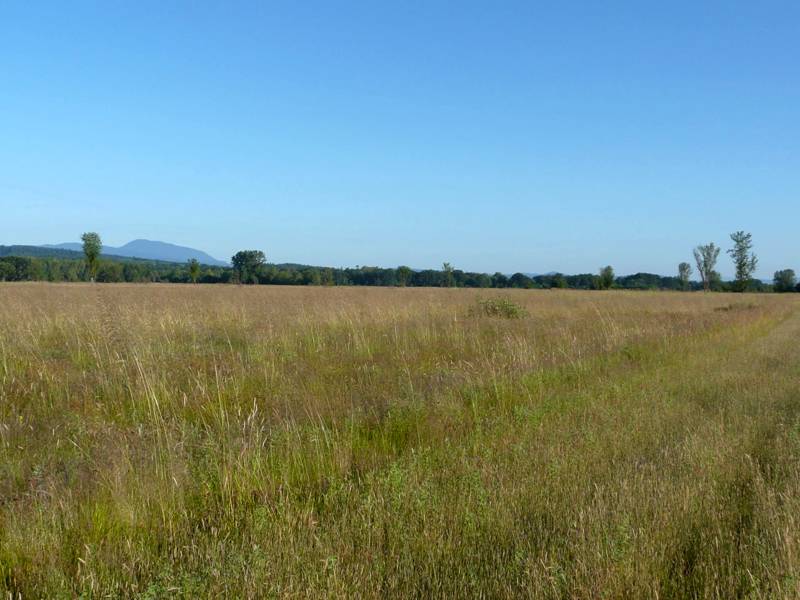
This is the prairie at the northeast corner of Finley National Wildlife Refuge (Birding Oregon p. 84).  The bird diversity in prairies is often pretty low, and you get rather damp walking through shoulder-high grass on a dewy morning, but I always enjoy exploring grassland habitats.

savannah at finley
Savannah Sparrow was the most numerous species by far. This distant grainy photo is typical of my efforts to capture this species. They either flush right at your feet, or perch on an exposed twig so they can see you coming a mile away. Western Meadowlarks and Western Kingbirds were also present, but equally un-photogenic.

harrier3
This male Northern Harrier hovered over me for a while. I was apparently too close to his nest. I kept moving.

bull elk
This bull Roosevelt Elk was completely hidden by the grass until he stood up. It seems odd to me that this large beast, who could trample me into the prairie sod without so much as breaking a sweat, would be intimidated by this little vegan biped. But I guess some of the bipeds this guy encounters are packing rifles or bows, so it is probably a good thing to be wary.

elk herd 2
Here are a few more of the herd. See the two babies? The female in the middle has her tongue out, but I don’t think that was directed toward me.

Pinyon Jay

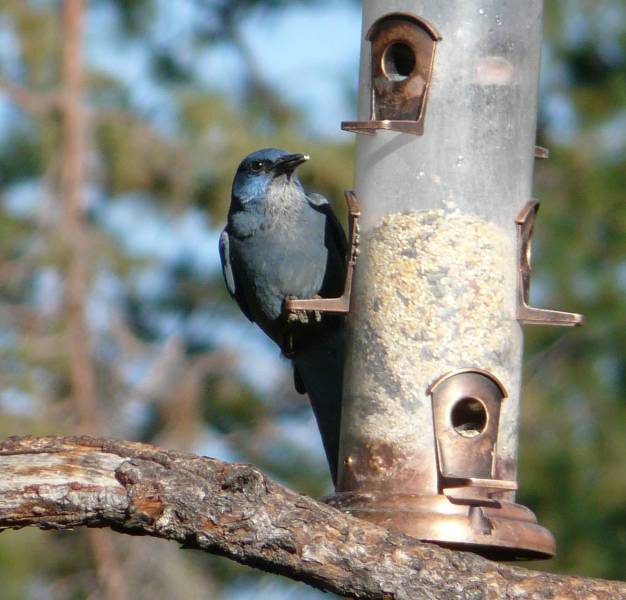
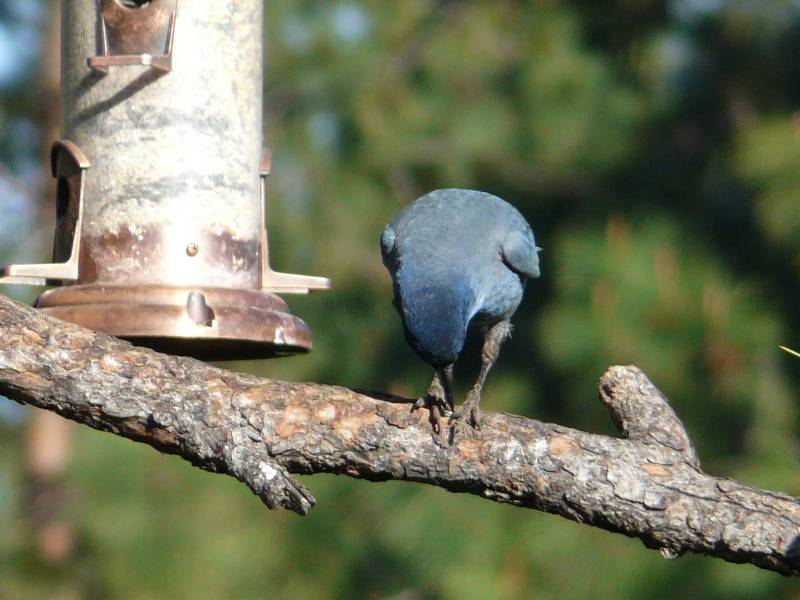
On a recent trip to Sisters, OR, I enjoyed watching Pinyon Jays come to the bird feeders at our hotel. These are fun birds, always in a group and always calling.

pinyon crown
This bird shows off his lovely cerulean blue crown.

pinyon front
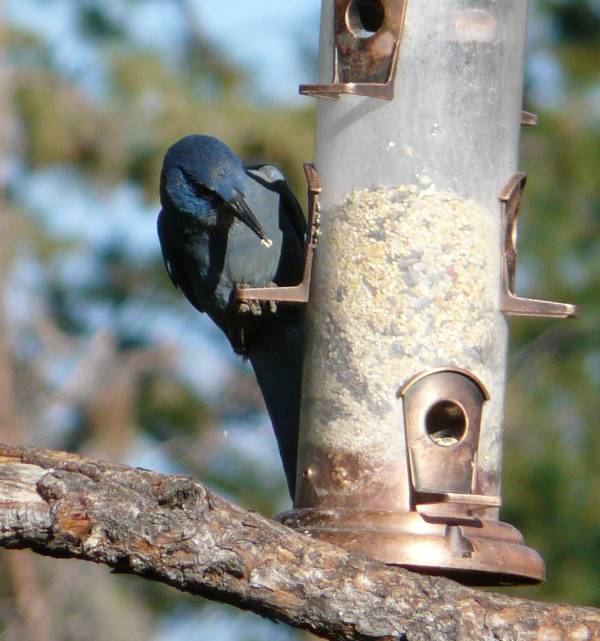
The throat is the only part of this species that isn’t blue.

pinyon with food

pinyon profile
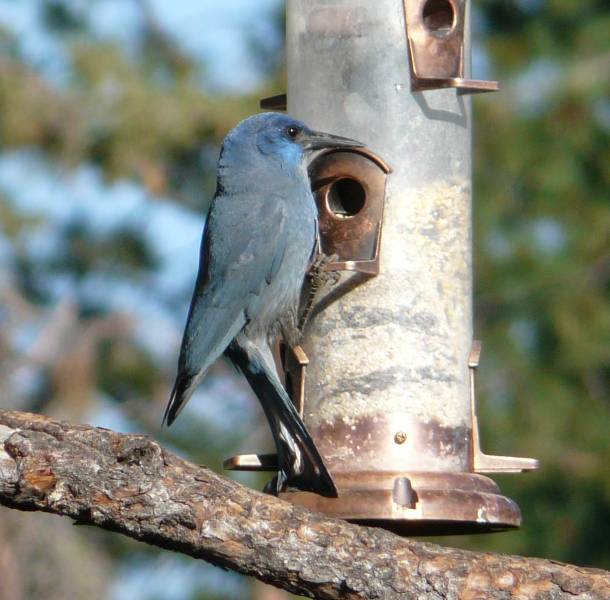
This profile shows off the bird’s long bill, handy for harvesting pine nuts when the bird isn’t slumming it at the feeder.

Bad Bird Photograph ID Quiz

Because if birds always looked like they do in the magazines, birding would be too easy.

quiz
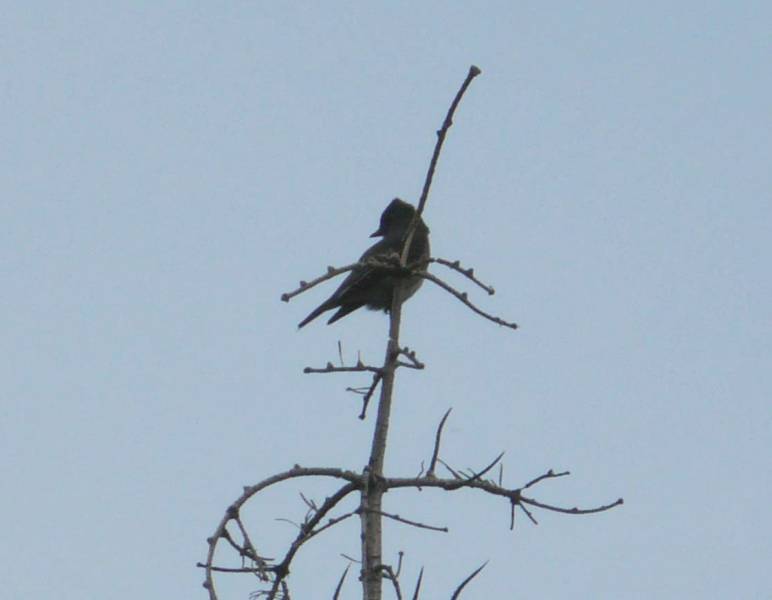
Here we have a photo of a distant bird, backlit, in low light. It was taken on the east slope of the Cascades on May 29. We can’t see much in the way of color or feather detail. But we do have some clues to the bird’s ID.

1. The crown has a definite peak
2. If you look closely, you can seen a line of demarcation between the dark side and the lighter belly.
3. The bird is perched at the very top of a dead tree.
4. The bird appears rather stout.
5. There appears to be a bit of white at the side of the rump.

So what bird is this? Leave a comment with your answer. I’ll reveal the ID in the comments in a couple of days.

Crystal Springs in the Spring

I visited Crystal Springs Rhododendron Garden (Birding Oregon p. 69) on May 28. This site is best known as a good spot for wintering waterfowl. This late in the spring, most of the ducks and geese have moved on, leaving just a few resident species. But even with the lower diversity, it is still nice to be able to get such close looks at birds that are normally much more “wild” in other locations.

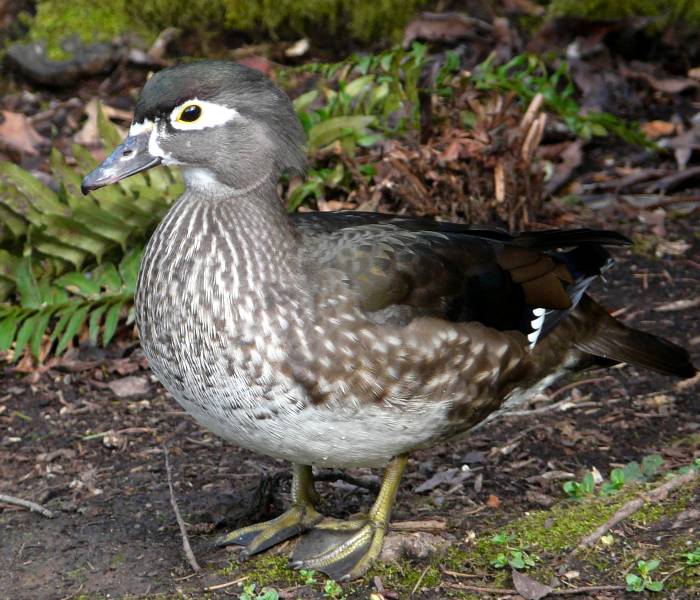
wood duck female
Wood Ducks are always a treat.

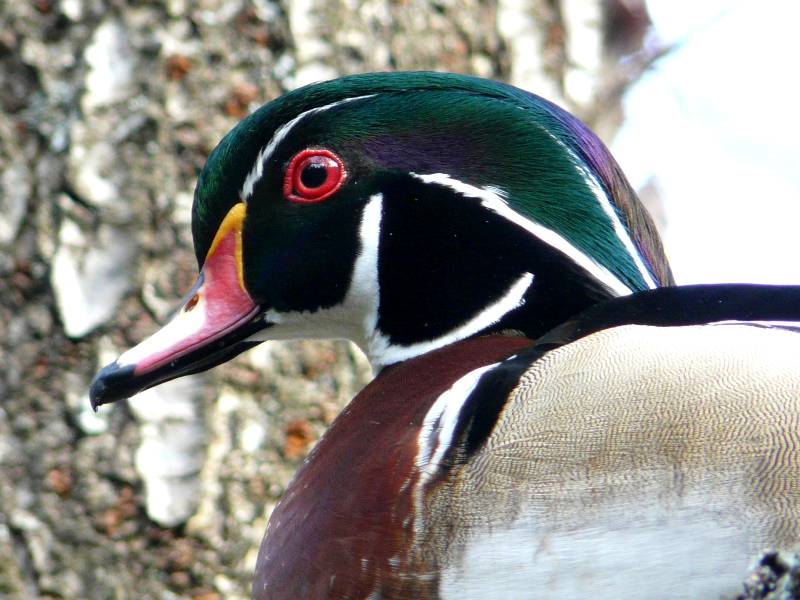
wood duck male
This male Wood Duck was in a tree, providing a view of the white throat.

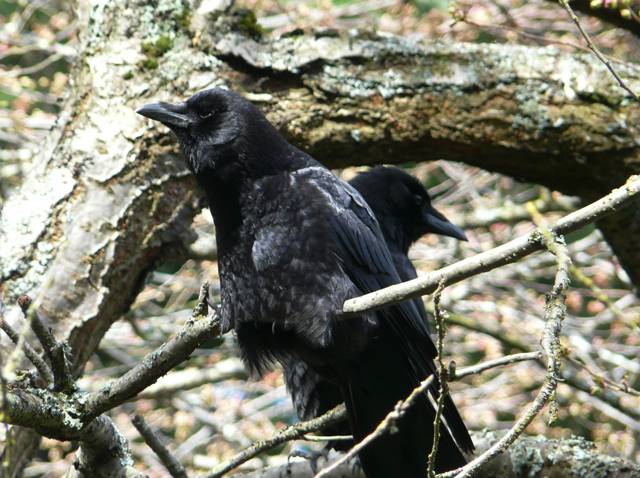
crow
American Crows in the bright sun showed some interesting feather patterns.

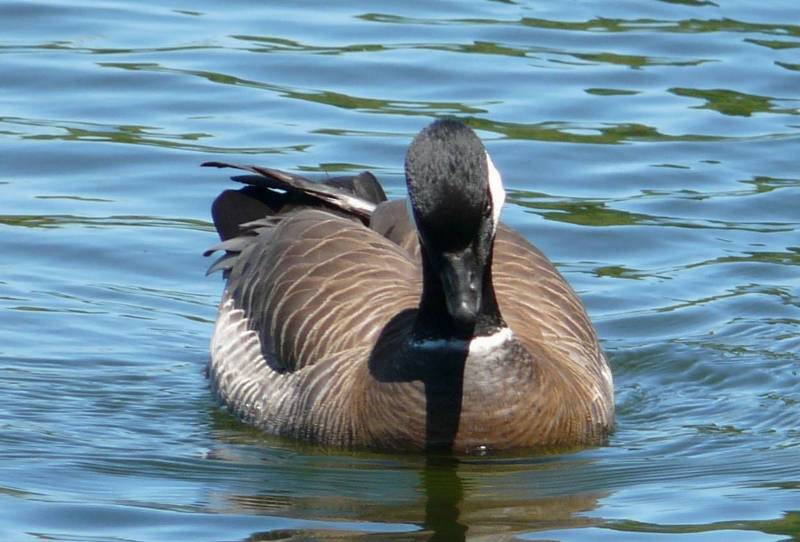
cackling2
Two Cackling Geese (Branta hutchinsii minima) were still present. This is a very late date for this species to still be in Portland. This species nests on the Arctic tundra, so most have left by mid-April. Perhaps these two thought that a summer on the duck pond would be nicer than flying all that way.

cackling 1
Here is another view of the Cackling Goose. Notice how far the wing tips extend beyond the tail. Long wings are typical for species that migrate long distances.

Purple Martins

purple martin

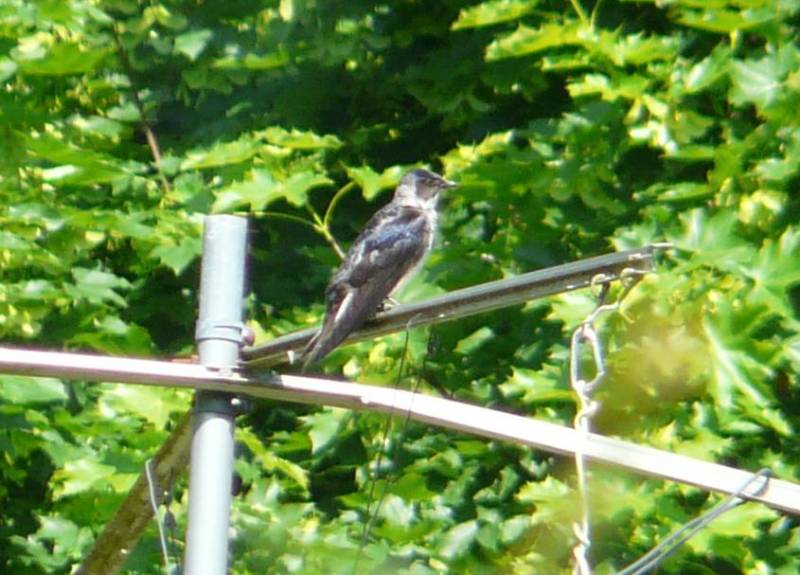
I always enjoy checking out the Purple Martin houses behind a home on Sauvie Island.  These large swallows are one of the more popular yard birds in the eastern U.S. , but the species is much less common in the West. This site on  Sauvie Island is one of the few places in the Portland area to find them.

martin nest
Here a female is putting nesting material into a martin house. The “natural” nesting habitat for Purple Martins is a cavity, usually an old woodpecker hole. But for the past two centuries, most of the population has chosen to nest in man-made structures.

Spring Creek Great Gray Owl Management Area

Our Portland Audubon Birdathon team visited the Spring Creek area of Wallowa-Whitman National Forest (Birding Oregon p. 47). This area is best known for Great Gray Owls, but other good birds are found here, as well. The owls nest on platforms provided by the Forest Service. This helps the birds to nest successfully, and makes it easier for birders to find this rather elusive species.

great gray
This individual seemed pretty comfy on her platform.

Portland’s hilltop migrant traps

In the current issue Birder’s World,  I have a site guide for Mount Tabor Park in southeast Portland. Mount Tabor is a forested hill (actually an extinct volcano) surrounded by residential neighborhoods. The elevation and vegetation attract good numbers of migrant songbirds every spring. A similar effect can be seen at Pittock Mansion in northwest Portland.

mt.tabor
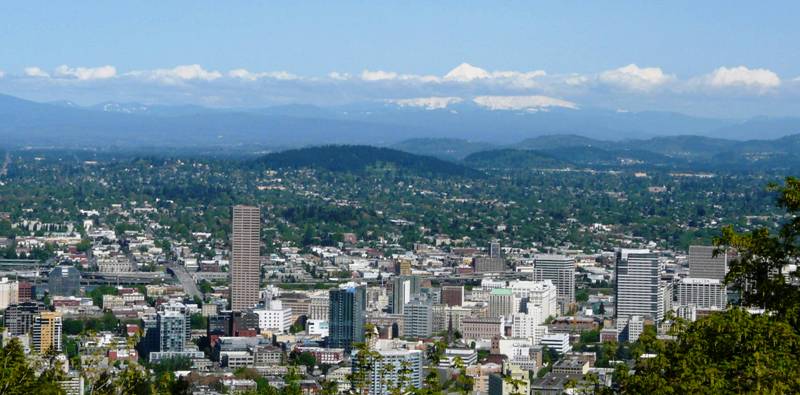
Here is the view from Pittock Mansion, with snow-covered Mount Hood in the distance. The forested hill in the center of the photo is Mt. Tabor. You can see how these islands of habitat rising above the urban sea would be attractive to migrants.

Shorebirds at Grays Harbor, WA

I took my shorebird class to Grays Harbor in Washington, one of the prominent staging areas for migrant shorebirds on the West Coast. The cold wet spring continues, so diversity was a little low, but there were lots of birds to see.

godwits-sbdowitchers
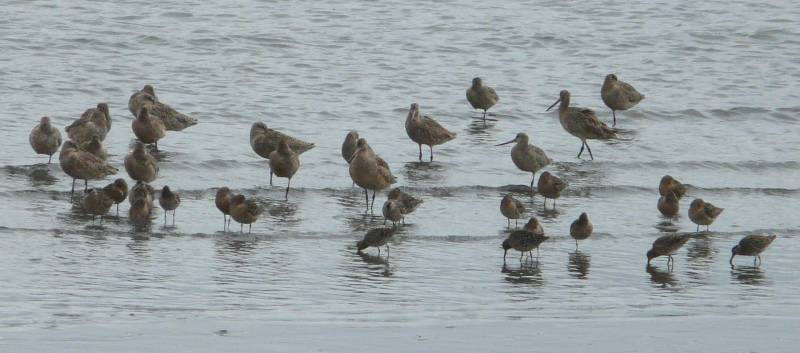
At Damon Point State Park, near the mouth of the bay, we found good numbers of Marbled Godwits and Short-billed Dowitchers.

flight
At Bowerman Basin, part of Grays Harbor NWR, a long boardwalk extends along the edge of the mudflats. As the basin fills with the rising tide, the birds are pushed closer to shore for excellent views.

mixed-flock3
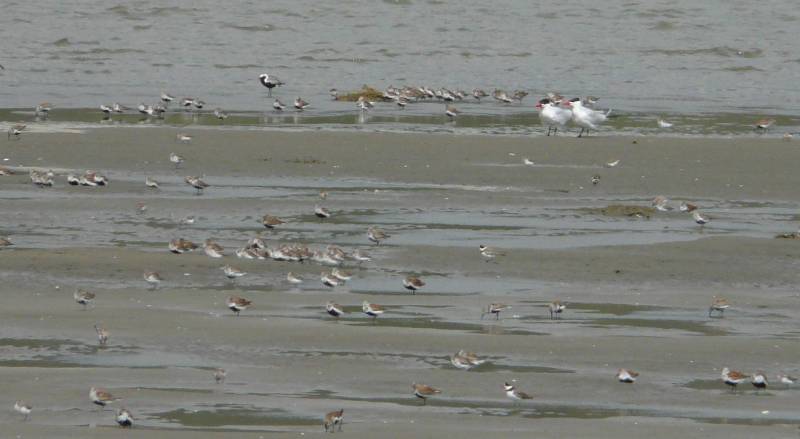
Here we can see a Black-bellied Plover, a couple of Semipalmated Plovers, two Caspian Terns, lots of Dunlin, and some Western Sandpipers.

semiplamated-plover
Here is a closer look at the lovely Semipalmated Plovers mixed in with Western Sandpipers.

western-least
I didn’t notice the bird at the time, but when I downloaded this shot of Western Sandpipers I immediately noticed the Least Sandpiper among them. Least Sandpipers feed in a crouched position with their feet far forward. On closer inspection, you can see the tiny bill and the pale legs. (lower right corner, if you are still looking)

least-western
Here’s a closer look at the Least Sandpiper between two Westerns.

Nestucca Bay National Wildlife Refuge

Part of the Oregon Coast National Wildlife Refuge Complex, Nestucca Bay NWR is a collection of properties near Pacific City that provides pastures for wintering waterfowl and protects various upland and wetland habitats.

sign

The only unit currently open to the public is Cannery Hill. From US 101 about six miles south of Pacific City, turn west onto Christensen Road. Follow this road up to the parking lot, where there is a restroom and visitor information.

pasture

The lower parking lot overlooks several pastures. These are home to several subspecies of geese from October to April. Ten percent of the world’s population of Dusky Canada Geese winter here. The entire population of Semidi Island Aleutian Cackling Geese graze on similar pastures on the north edge of Pacific City, property recently acquired by the refuge.

From the parking lot, walk up the gravel road through mixed woodland and brushy habitats. At the top of the hill is another small parking lot (for those who can’t walk up), and a paved trail to an observation deck.

hilltop

From the top of the hill, you can see Haystack Rock, with Pacific City on the right, and views of the river and beach below. Check the grassland habitat on the hill for Western Meadowlark, Western Bluebird, and other open-country species.