Wild Turkey

Unique to the Americas, the two species of turkey are beautiful, huge birds.  Wild Turkeys are native to North America, while Oscillated Turkeys can be found in Central America. Close to extinction in the early part of the 20th Century, Wild Turkeys have made a tremendous comeback in their original range, and have been widely introduced elsewhere. While not native to Oregon, the Rio Grande race of Wild Turkey was introduced in 1975 and is faring well in much of the state.

Turkeys are known to most people not as a wild creature, or even so much as a food, but as a centerpiece on the table at Thanksgiving. It is tradition to serve these birds on that day. But when does a tradition become a ritual? It seems a bit creepy to me to sacrificially kill and eat a particular species on a particular day, just because we have always done so. Most people have never seen a Wild Turkey, or even a living domesticated one, and yet they perpetuate this rite without considering it.

I think turkeys can be far better appreciated in the field than on the table.  On a day set aside to acknowledge the abundance of life, we should celebrate living beings, not sacrificial ones.
turkey
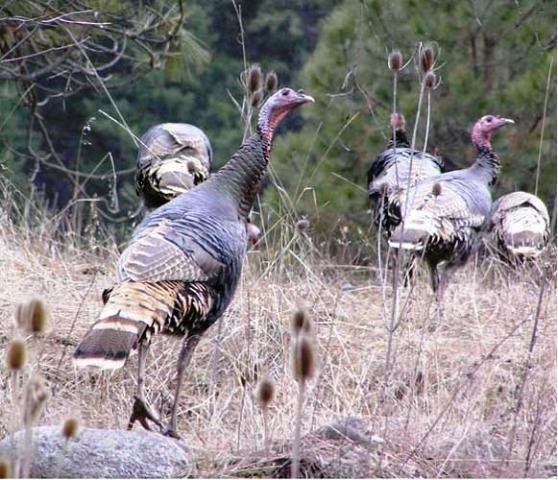
These are free-ranging Wild Turkeys in northeastern Oregon.
freerangeturkeys
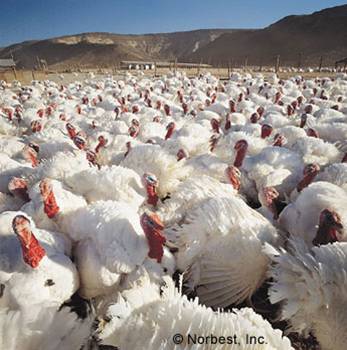
These are “free range” domestic turkeys. Selective breeding has made them into obese, pale shadows of their wild ancestors.

Another piece of equipment you should carry in the field

Birding can be a very simple pleasure. You really don’t need much to be a birder; a binocular to help you see the birds, and a notebook or field guide to help you identify what you see. There are lots of other pieces of equipment you could carry: more books, a scope, an MP3 player with bird songs, an external speaker for the MP3 player, and a fancy vest with lots of pockets to carry all this.

I generally don’t carry any of these extras, but there is one item which I now consider basic equipment: a digital camera. I don’t mean the full-sized camera bodies and gargantuan lenses used by actual photographers. I mean a small point-and-shoot camera. A small video camera would work, as well.  Digital photography has advanced so much in recent years that anyone can take decent photos with very small equipment.

Why should birders carry a camera? Because if you are out in the field enough, you are eventually going to run into something really extraordinary, some wonderful vagrant species or unusual behavior that needs to be documented. That’s not to say that a written description is not valid documentation, but nothing adds validity to your report like a photograph.

annas-hummingbird_john-rakestraw
From a photographic point of view, this is an awful picture. The photo was taken through my kitchen window, so it is a little dark and you can see the reflection of my microwave oven cutting across the lower portion of the image. The bird’s eye is obscured by the blossom and the slow shutter speed makes the wings invisible.

But despite this being a terrible shot, you can clearly see the bubble-gum-pink gorget and splash of color on the crown that identifies this bird as a male Anna’s Hummingbird. If this shot had been taken in an area where Anna’s Hummingbirds do not normally occur, it would be hailed as compelling physical evidence of a vagrant bird.

Most photos that I take in the field are not of vagrants, and most shots are deleted the same day I take them, but I still try to have my camera handy at all times, just in case.

Ankeny NWR

I took my Portland Audubon waterfowl class to Ankeny National Wildlife Refuge (Birding Oregon p. 86). The weather was glorious and the birds were abundant.

field-of-geese
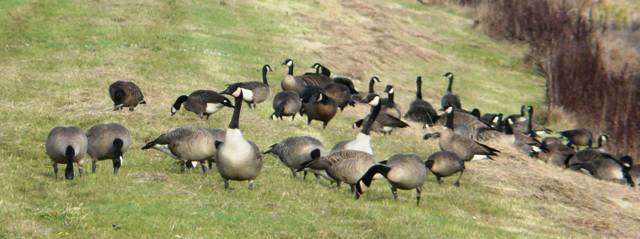
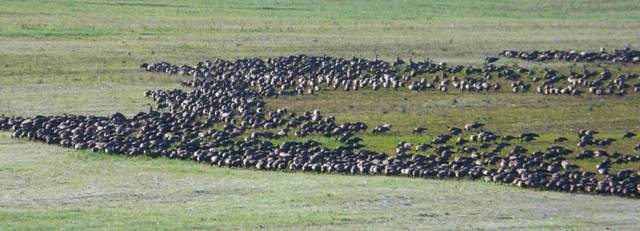
Many of the fields on the refuge hosted large flocks of geese, mostly the minima race of Cackling Goose.

mixed-geese1
This little mixed flock contains Western Canada, Dusky Canada, and Taverner’s Cackling Geese.

tundra-swans
Eagle Marsh held several dozen Tundra Swans.

Goose article on line

I am contributing the occasional story to Fisher Communications, the company that owns several television stations in the Pacific NW. (If you have reached this blog for the first time through that site, welcome.) The piece is on the large flocks of geese that winter in the Willamette Valley. Here’s the link.

feature-sized-geese

Great weather, if you’re a duck

I forced myself to go birding Saturday morning. It was one of those rainy November days when you want to hole up until May, so I forced myself out. (Can’t get tired of the rain this early in the season.) So I went to Smith and Bybee Wetlands in NW Portland. The rough weather kept most of the songbirds under heavy cover, but the ducks were out and about.

shovelers
While distant and poorly lit in the rainy weather, these ducks are clearly Northern Shovelers. The first clue is the fact that they are all swimming along with their faces in the water, typical shoveler feeding behavior. On the first and last ducks in line, you see a dark head, white breast, rusty sides, and white bottom, classic Northern Shoveler.

distant-ducks
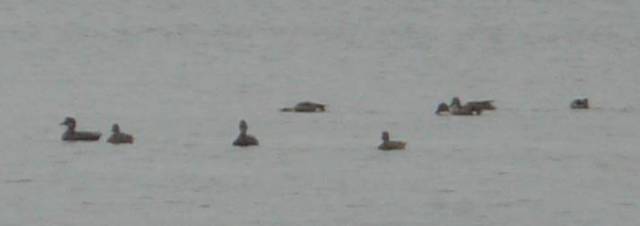
These birds were clear across the lake, but several are clearly identifyable. The line of four ducks in the upper right of the photo are Northern Shovelers, for the same reasons as in the photo above. The duck on the far left, and probably the bird next to him, is a Gadwall. The bird is slightly smaller than the shovelers, lacks any blatant pattern, seems to be dark on the backside, and has a blocky head shape.

The ability to ID ducks, or any other birds, at great distances is not so much a matter of skill, as it is familiarity. The more familiar you become with a species, the greater the distance you can recognize that species.

nutria
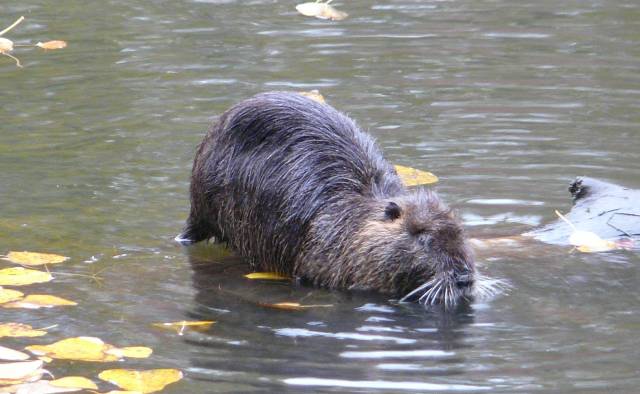
This Nutria was enjoying the day, munching away on something. Nutria are native to South America, but have been introduced in many areas by the fur trade. (and why would you want to dress yourself to look like a large aquatic rodent?) When raising Nutria failed to be profitable, many were released into the Pacific Northwest, where they flourish at the expense of some native mammals and wetland plants.

Parking Lots

They paved paradise, and put up a parking lot.  – Joni MItchell

One of the more common abominations of our society is the parking lot, that large expanse of asphalt or gravel that raises local temperatures, eliminates vegetation, and changes the local hydrology. It is a symptom of our car culture, and will probably be with us for the foreseeable future.

But if you are one of those folks who are “always birding,” then you will occasionally find interesting birds even in the asphalt prairies of your local shopping centers. Not that I recommend parking lots as birding destinations, but if you keep your eyes and ears open, there are birds to be found in the skies, on the asphalt, and in the isolated shrubbery of the parking lot.


A gorgeous species with subtle purple and green irredescense, Brewer’s Blackbirds are frequently encountered in parking lots.


Parking lots are often the best spots to study gulls. The birds here are used to people and can often be closely approached. This is a first-cycle Herring Gull.


Adult California Gull

Not all parking lot birds are blackbirds and gulls. I have seen Peregrine Falcons, Black Swifts, Anna’s Hummingbirds, White-crowned Sparrows, Gray-crowned Rosy-Finches, Snow Geese, and Cooper’s Hawks, to name a few. Keep alert, and the occasional avian treasure will appear even in the desolation of the parking lot.

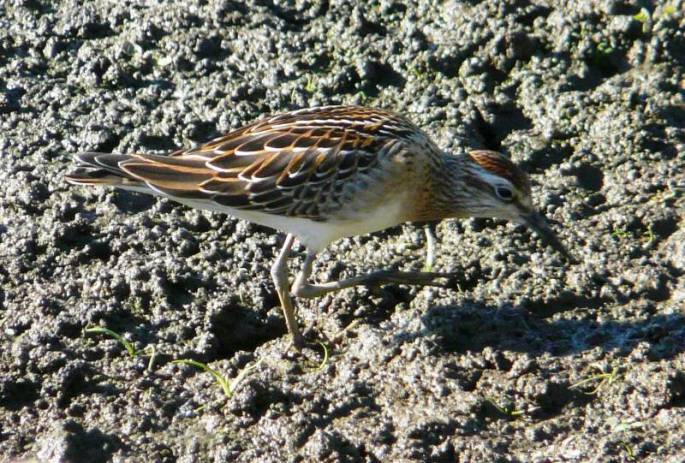
Sharp-tailed Sandpiper

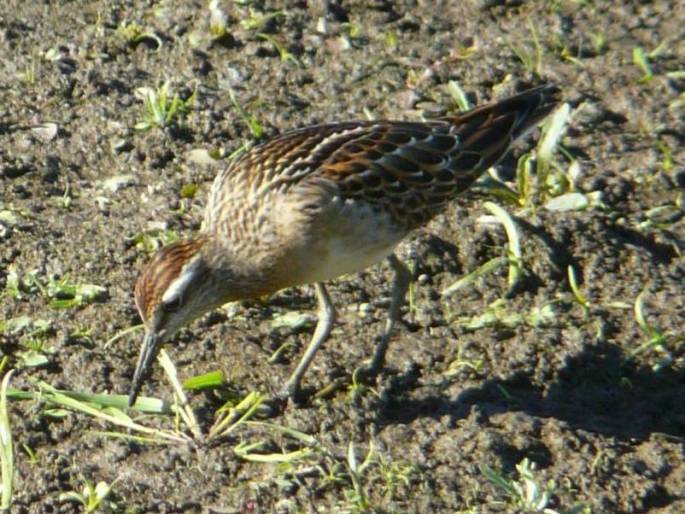
I enjoyed watching a Sharp-tailed Sandpiper at Fernhill Wetlands this afternoon. While most Sharp-tailed Sandpipers migrate from Siberia to Australia via the coast of Asia, a few young birds work their way down the west coast of North America before crossing the Pacific. The pattern on this species is quite stunning, at least by shorebird standards.

Mount Hood

I drove up to Timberline Lodge on Mount Hood today. This is a great area to search for alpine species, and the paved road makes it easy to access. Autumn has settled in already, with a fresh dusting of snow on the mountain. The ground had frozen overnight, and the thawing this morning released a near constant stream of falling rocks on the gravel slopes. (While it looks very dramatic when covered in snow, Mount Hood is actually a big pile of gravel and fine volcanic ash.) Most of the birds seem to have left the area around the lodge for lower elevations. I found a couple of Golden-crowned Sparrows, Robins, and Red-breasted Nuthatches. A flock of ten Common Ravens rode an updraft around the summit.


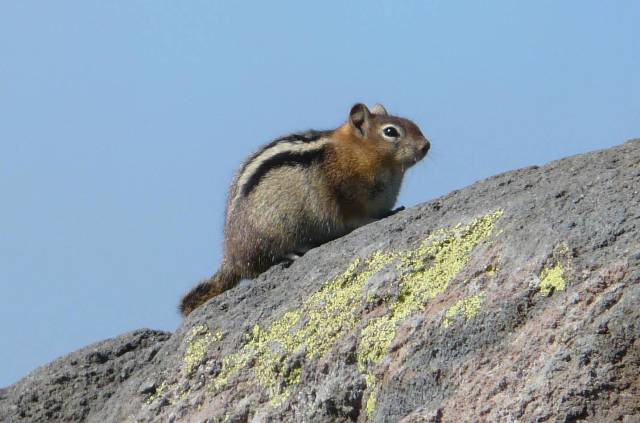
Golden-mantled Ground Squirrels are common on Mount Hood.

After descending the mountain, I visited the meadows and forest around Little Crater Lake (Birding Oregon p. 75). Gray Jays and a Pileated Woodpecker were the bird highlights. The color of this little lake is an eerie turquoise. Despite the near 40′ depth, you can see the bottom in great detail.

And More Shorebirds

Another quick trip to Fernhill Wetlands this afternoon produced a couple of species that were not present a few days ago.


A Long-billed Dowitcher (left) and a Pectoral Sandpiper. Both birds are in juvenal plumage, indicated by the pale edges on the scapulars and wing coverts which create a scaly pattern. The Pectoral has a clump of mud on the base of his bill.


Another view of the Pectoral Sandpiper with two Long-billed Dowitchers. The crouching posture suggests that the bird is on alert and ready to flush. That is a good clue for the birder to back off.


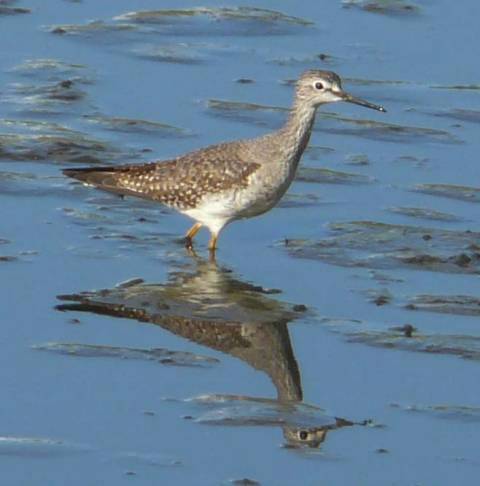
A Lesser Yellowlegs.   


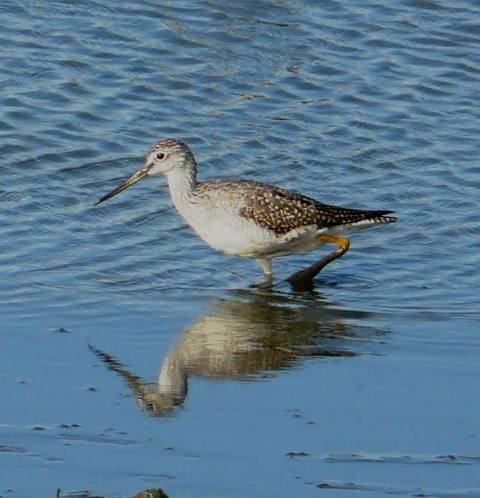
Greater Yellowlegs on the left, Lesser Yellowlegs on the right