Shorebirds

The big news in Oregon birding this week is the Wood Sandpiper found at Fern Ridge Reservoir west of Eugene (Birding Oregon p. 90). This is the first record for Oregon, and one of only a few records for North America south of Alaska. Of regional interest was a Buff-breasted Sandpiper at Tualatin River NWR, just west of Tigard. I wasn’t able to chase either of these birds, so I had to settle for a few more common species at Fernhill Wetlands (Birding Oregon p. 61).


While we can’t see the bill on this individual, the bold stripes and orange tail identify this bird as a Wilson’s Snipe.
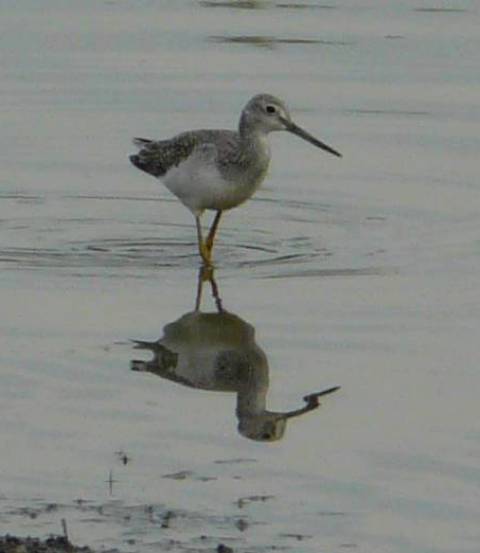

Here is a Greater Yellowlegs. The bill is more than half the total length of the head. On a Lesser Yellowlegs, the bill is about half the total head length, and the bird is considerably smaller overall.
Autumn Movements

With the autumnal equinox this week, we are seeing migrants returning to the Willamette Valley. The first flocks of Cackling Geese have arrived along with good numbers of Greater White-fronted Geese. The brambles are once again hosting Golden-crowned Sparrows.


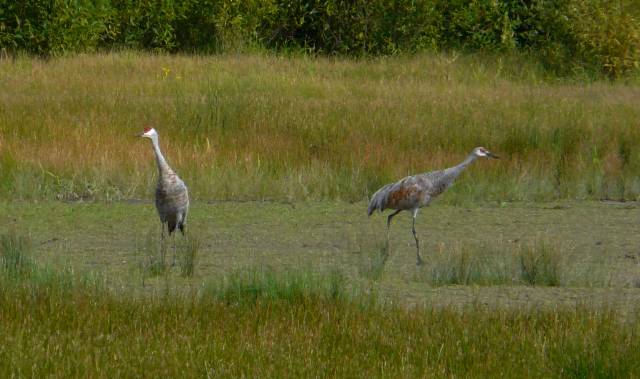
Sandhill Cranes are gathering on Sauvie Island (Birding Oregon p. 55). These birds were seen along Sturgeon Lake on Oak Island.


Flocks of Yellow-rumped Warblers were moving through the woods and brushy areas of Oak Island today. This individual is a female of the Myrtle race. Notice how the white throat is cleanly separated from the gray cheek, with the white starting to wrap around the ear coverts. Audubon’s race does not show this clear demarcation.

The best laid plans

It is sometimes the case, when I plan to look for a certain type of bird, that my target species are nowhere to be found. On those days we have to let go of our expectations and open ourselves to whatever treasures the birding fates have for us. I helped with a field trip today that was supposed to visit a hawk watch site. The ridge was completely socked in by low clouds, so we had to scrap our plans and instead birded open range and farm land.

Likewise, I recently visited Fernhill Wetlands (Birding Oregon p. 61) to look for shorebirds. Despite the decent amount of mudflat habitat available, shorebirds were almost non-existent. While I was disappointed in the lack of waders, there is always something interesting to watch.


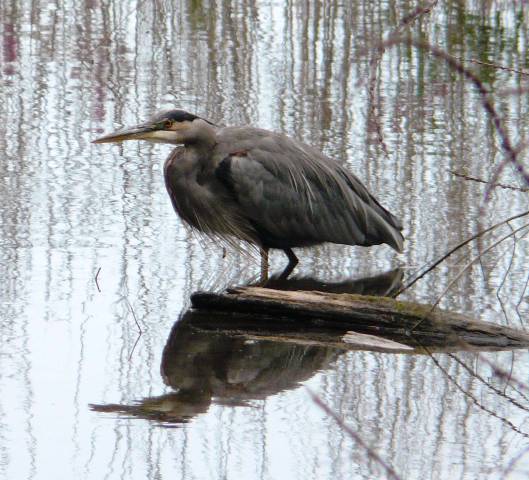
Always common, but always worth a look, Great Blue Herons will often surprise you with the interesting creatures they are attempting to swallow. On this day I watched one bird swallow a large catfish.


Great Egrets congregate this time of year to fish in the receding waters.


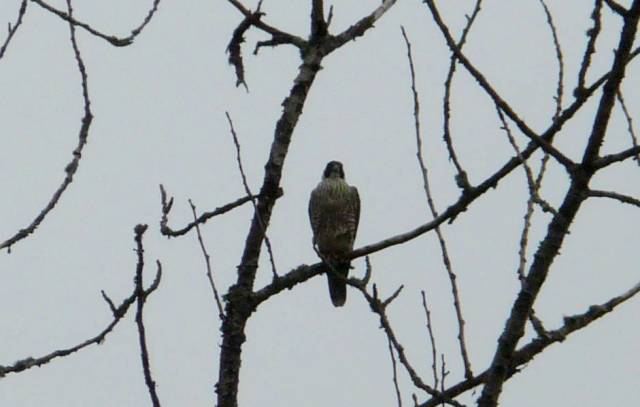
This Peregrine Falcon was keeping watch over the wetlands. This might explain the lack of shorebirds.


We are still in the “ugly brown duck season,” when many birds are still in eclipse plumage. Despite the lack of characteristic colors, most birds can be identified by shape or by tell-tale field marks. This picture shows two Northern Pintails on either side of a Green-winged Teal. The pintails are identified by their pointy backsides and their blue sloping bills. The tiny teal is displaying the green speculum on the wing that give the species its name.

Ghost revisited

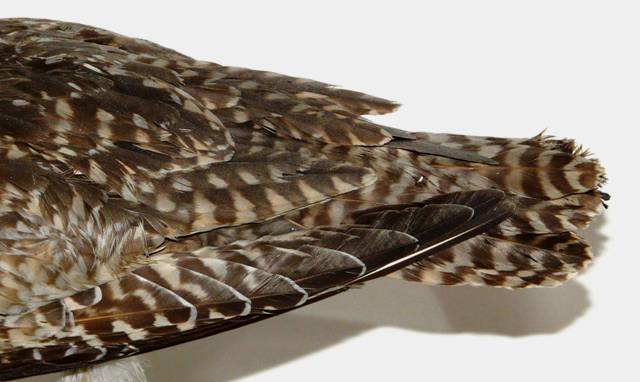
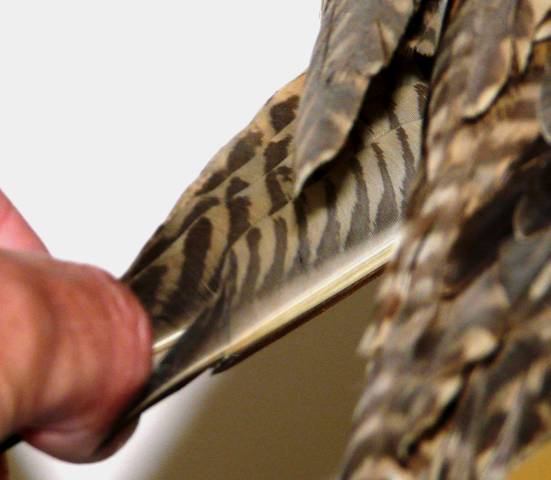
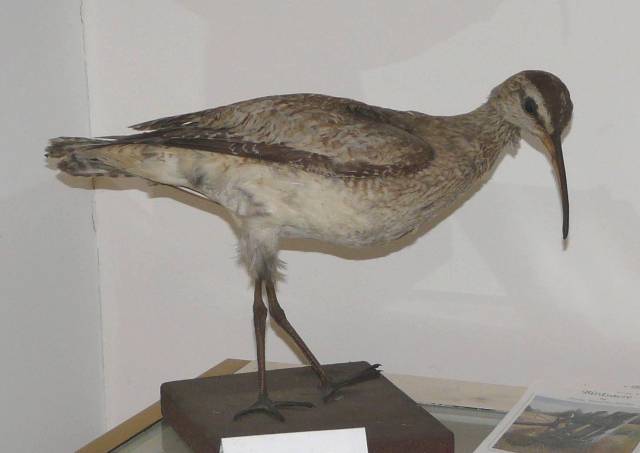
Of those who commented on the shorebird mount from Maine, some were convinced the bird was an Eskimo Curlew, some felt it was a small Whimbrel, and others said that the key field marks for distinguishing the two were not visible in the photos. So I went back today for a better look. When I arrived at the visitors’ center, no one was around. So I became “one of those people” who ignore the signs that tell you not to touch the displays. Here is what I discovered.

The wing tips do not come close to the end of the tail. On an Eskimo Curlew, the wing tips would normally extend beyond the tail.

And here is the clincher. The underside of the primaries are heavily barred. The primaries on an Eskimo Curlew would be solid gray. So we apparently have a small Whimbrel with a rather diminutive bill.

Personally, I was hoping the specimen was an Eskimo Curlew. That was my first impression when I saw it. But it is currently impossible to learn the “jizz” of an Eskimo Curlew. All we have are study skins and taxidermy pieces, all over a century old. I am hopeful that this species still exists. Perhaps we will have a chance to study living examples one day.

Ghost

I found this mounted shorebird at a little bird sanctuary in Ellsworth, Maine. It is part of an ancient taxidermy collection that was donated to the visitor’s center. The gentleman I spoke to did not know the history of the mount or the identity of the bird. My heart skipped a beat when I first saw the mount, but now I am not so sure. The mount is in terrible condition with extensive foxing and ruffled/damaged feathers. Please give me your ideas about the bird’s ID and how you eliminated other species.

Taverner’s Cackling Goose vs. Lesser Canada Goose

As I continue my study of the white-cheeked goose complex, I often return to the problem of separating Taverner’s Cackling Goose (Branta hutchinsii taverneri) and Lesser Canada Goose (Branta canadensis parvipes). Some sources argue that we shouldn’t be attempting to separate these two in the field until more study is done. Other sources claim to have definitive field marks for each. Some sources contradict each other as to what those definitive field marks are. So here are few photos from my recent goose encounters along with my opinions/guesses about their subspecific identity. I welcome your opinions and comments. (The comment,”Get a life!” is obvious and does not need to be repeated here.)

taverners-lesser.jpg
#1. The length of a goose’s neck appears to vary with the bird’s position, so it is dangerous to judge neck length from a single photo. But the bird on the right appeared consistently longer-necked than the birds on the left. A long thin neck supports the ID of Lesser Canada while the shorter thicker necks suggest Taverner’s Cackling.

western-lesser.jpg
#2. The large geese in the background are Western Canada Geese (B.c. moffitti). The smaller bird in front shows a fairly long bill that slopes gently onto the forehead. This head shape is consistent with Lesser Canada Goose.

tav-mallard.jpg
#3. The bill on this goose is on the short side, and the forehead angles steeply up from the base of the bill. These features, along with the thick neck, suggest Taverner’s Cackling Goose.

tav-lesser.jpg
#4. The bird on the left looks good for Taverner’s Cackling Goose, with its short bill and very steep forehead. The goose to the right seems to show a gentler slope to the forehead. Is this just an illusion caused by the different neck position, individual variation, or a slightly short-billed Lesser Canada? It is at this point that my eye is drawn back to the gulls, a much easier bunch to sort out.

Cackling and Canada Geese

My current birding project is studying the various races of Cackling and Canada Geese (Branta hutchinsii and Branta canadensis). Canada Goose was split into these two species in 2004. There are multiple races of each, so it is a good idea to become familiar with all the different forms in case more splits occur. If nothing else, it adds a bit of a challenge when confronted with a large congregation of geese.

In the Pacific Northwest, there are four races of Canada Goose (Western, Vancouver, Dusky, and Lesser) and three races of Cackling Goose (Taverner’s, Aleutian, and Cackling). The greatest identification challenge seems to be differentiating between Lesser Canada Goose and Taverner’s Cackling Goose. The two overlap in size and color, and different sources give conflicting information about their characteristics. The best field mark on close birds seems to be the shape and relative length of the bills; short and steep on Taverner’s, longer and more sloping on Lesser Canada.

Here are a few websites that you may find helpful in learning the various races of white-cheeked geese.
http://sibleyguides.com/canada_cackling.htm David Sibley’s notes that were written just after the species were split. Good information, but not complete, especially regarding the Lesser Canada/Taverner’s Cackling issue.

http://www.idahobirds.net/identification/white-cheeked/subspecies.htm Harry Krueger’s site. This is a work in progress, but it offers great information on several subspecies.

http://www.dfw.state.or.us/resources/hunting/waterfowl/goose-permits/Goosefieldguide_2ndEdition_final.pdf This 83-page publication from the Oregon Department of Fish and Wildlife is a wealth of information and photographs. Be warned; this publication is intended for hunter education, so some of the photos are of “harvested” birds.

geese.jpg
Cackling Cackling Goose (top) and possible Lesser Canada Goose

Answers to 2nd cycle gull quiz

california2.jpg California Gull
The first impression you get of this bird is its long lean look. The bill is long and thin, with a distinct dark band near the tip. The body is fairly slender and the dark wings appear very long. Despite the strong light in this photo, you can still make out the bluish gray color on the joints of the yellowish legs.

western2.jpg Western Gull
Two words: Bulky and Dark. The bill is very thick. Although shades of gray are very hard to judge in photos, the mantle color of this bird seems pretty dark. The tertials are blackish. The primaries and tail are black. This much contrast on a large pink-footed gull points toward Western.

glaucouswinged2.jpg Glaucous-winged Gull
Like the other age classes of Glaucous -winged Gull, this bird shows a general lack of contrast. The mantle is a little gray, the primaries are a little brown, but everything on this bird blends together really well. A Glaucous Gull would show lighter primaries, while a Western hybrid would show much darker.

2nd cycle gulls

Since I am still in “gull mode” from my class at Portland Audubon, here is another gull quiz. These three birds are in their second plumage cycle; still pretty brown and blotchy, but with some gray coming in on the mantle. All three were photographed in Oregon in autumn. Don’t worry. Pretty soon migration will pick up and my attentions will be drawn to other birds.

california2.jpg
Number 1

western2.jpg
Number 2

glaucouswinged2.jpg
Number 3

Answers to Gull Quiz (look at the quiz first)

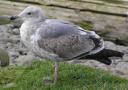
#1 Glaucous-winged Gull
glaucous-winged1.jpg The first thing you notice about this bird is the lack of contrast. The pattern is soft and blurry, and the primaries and tertials are the same color as the rest of the bird. The big head and substantial bill are also good for this species.

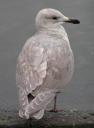
#2 Thayer’s Gull
thayers1.jpg The pattern on this bird is very crisp, almost checkered. The tertials and primaries are darker than the rest of the bird. The primaries are two-toned; a dark leading edge and a pale trailing edge. This is the classic mark for Thayer’s Gull. The round head and thin bill are also important marks.
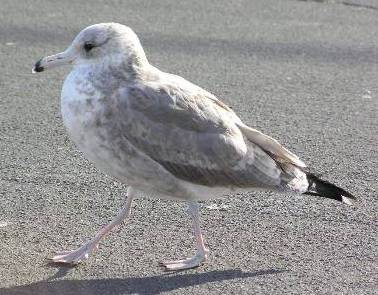
#3 Herring Gull
herring1.jpg This bird’s pattern is fairly dark, but not as crisp as the Thayer’s. The tertials and primaries are blackish, and mostly solid. Note the sloping forehead and two-toned bill (heavier than Thayer’s but still fairly thin).

So now go to your local parking lot or beach with a few cat treats and take another look at your local gulls. There is great beauty to be found in subtleties.